15.6.06

Levine's Judaica


Levine's Judaica recently featured the book I co-authored - EMBRACING LIFE AND FACING DEATH in their catalog - thanks to everyone at Levine's! You can check it out here. They have one of the largest catalog's of Judaica I know of - a full line of inflatable matzoh balls.

Cokie Roberts Video


The event I worked on with Auburn Media - starring MC Cokie Roberts is now online. Here's the video link
Cokie talked about her mother (the former U.S. ambassador to the Vatican and a resident of Bourbon Street) and she was both funny and articulate about the way that the media distorts religious voices. Best of all, this lo-tech video captures the crowd laughter and overall energy of the room. She comes on after Macky Alston's intro.

14.6.06

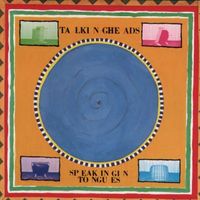
Speaking in Tongues


Last week we had our faculty development seminar up at Auburn (which I enjoyed leading with Lucinda Mosher.) We had faculty from ten seminaries participating, and looking at the question: "What do we teach about the 'religious other' and why?"

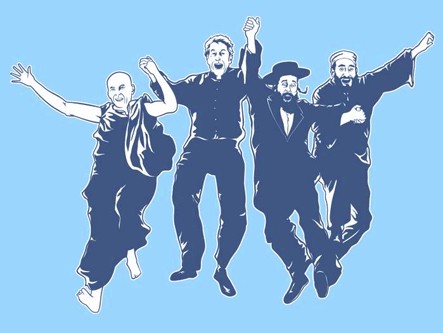
In addition to sharing ideas on how we teach, we went together to the Lotus Fire Zen Temple to speak with Sensei Shugen Arnold, shared a morning with Muslim physician and lay religious leader Dr. Faiz Khan, and went to B'nai Jeshurun for Kabbalt Shabbat. One of the best features of the group was the religious diversity - particularly the presence of two Pentacostals, an Orthodox rabbi (Tsvi Blanchard) , and one prof who teaches at Illif who is a devout atheist.

Although I resonate with the mystics, I think that it is important to point out that religions do not teach the same essential truths - take the following contrast:

One of the pentacostals spoke a bit about 'speaking in tongues' - and the role of 'not knowing' - of not having a rational/logical spiritual practice, but rather an ecstatic, out-of-body encounter of God. Sensei Shugen's practice is the exact opposite - a somber silence that speaks to the knowing of enlightenment.

On Monday I stopped by Village Thrift in Philly - vinyl acquisitions include: Jimmy Swaggart on piano, Ukranian Comic Songs, Partridge Family, and Lawrence Welk. The Ukranian LP is in Ukranian - with song titles 'Matchmakers in Saloon' and 'Party at the neighbors.'

1.6.06

Letter from Eric Shockman

Dear Rabbi:As you know, Thursday evening we usher in the holiday of Shavuot. And, as you know, in addition to marking the anniversary of the giving of our Torah, Shavuot also marks the time when farmers used to bring the first fruits of their crop to the Temple as bikurim (offerings).MAZON has long been proud of a religious and cultural heritage that emphasizes the continued importance of symbolic bikurim. Though the Temple no longer stands, today we act as a community to perform this mitzvah by providing offerings to those who are in need.Whereas once we honored God by delivering fruit baskets to the Temple, today we show our gratitude and respect by sharing our abundance with parents and children most desperately in need.At no time has this mitzvah been more urgent than today. Facing the unimaginable horror of genocide, millions of Sudanese villagers have fled their homes with nothing but the clothes on their backs. As they seek safer ground across the border in Chad, the Darfurian refugees must also struggle to find the most basic of necessities: food.That is why we need your help. MAZON is working to make a critical difference in the region, work made more urgent by the United Nations' recent announcement that its World Food Program is being forced to halve its emergency rations in eastern and western Sudan. This comes during what is already known as the “hunger season,” the annual pre-harvest period from July to September, when needs are greatest.To help combat this catastrophic shortage, MAZON is asking you to urge your congregants to provide aid to struggling families throughout the region through our Food for Darfur & Chad fund. Donations can be made directly at our website: www.mazon.org; simply indicate on the web donation form that your gift be used for Darfur relief.As always, you have our humblest thanks for your continued partnership, and our deepest respect for your commitment to making this Shavuot holiday one of study, reflection and meaningful bikurim.B'Shalom,H. Eric Schockman, Ph.D.PresidentMAZON: A Jewish Response to Hunger1990 S. Bundy Dr., Ste. 260Los Angeles, CA 90025(310) 442-0020

31.5.06

Shavuot Poem


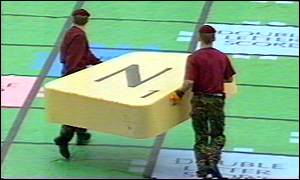
Double Word Score

Intermediary objects –
tablets, scrolls, books,
It’s all code,
chicken scratches, really,
God as text, as word, as story, as law,
language is a cousin once-removed,

Meditate on these words,
Really meaning go beyond the words,
Place them upon your heart,
Meaning tuck them somewhere inaccessible,
Write them on your doorposts and gates,
Then paint over them with smooth strokes in a latex semi-gloss,
Teach them on the way,
Open up the sunroof and throw them out the window.

It is not the words,
That is what the masters always say,
But we novices have secret crushes on words like
Supplication, wave-offering and breastplate
Because words are entire worlds,
We crawl up in them like a…
like a…
like a…
womb
waiting to be birthed into the world beyond beyond.

The inquisition - what a show!


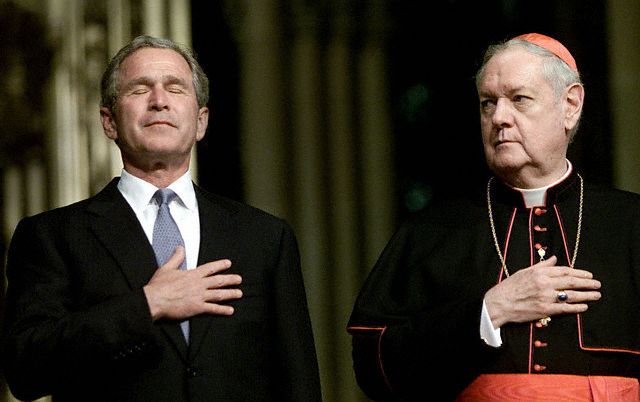
So last night I was with a crowd of other Jewish professionals at the Jewish Center, the Orthodox shul that once was led by Mordecai Kaplan. That, I admit, is not blog-worthy. What is worth noting, though, is that the event was a lecture by Cardinal Egan. A bishop preaching from the pulpit in an Orthodox shul - I can hear Mel Brooks in my head "What is this? the inquistion?" I hate to to say it, but the forced sermons of the inquistion would have been more engaging than his extended shmooze. The bishop spoke personally about the many Jews in his life growing up in the Chicago suburbs (naming countless Jewish sounding names that were familiar to few if any in the crowd) , he delivered stale jokes about bagels and smoked salmon (three times), and he recalled civil rights and labor struggles that were old news thirty years ago. He had suprisingly little - or rather I should say nothing - to say about the current social climate except that we should work together on the pressing issues of our day. He did not give any hint to what those issues might be. Sadly, this was yet another example of a missed opportunity. Maybe the real dialogue happens back stage - or at the bar after the lecture - but it certainly was not evident in the shul. I did get to meet an interesting Catholic professor from Iona - and the reception featured a nice samosa like puff thingy.

25.5.06

Pretty Fly for a Rabbi


I once saw Weird Al Yankovich, the Polish American king of pop satire, in an elevator in Winston-Salem, North Carolina. Many years back, he spoofed the song "pretty fly for a White guy" with his "Pretty Fly for a Rabbi" replete with fake Yiddishisms. Now some genius has married Japanese anime and Weird Al and alas, another chapter of the Jewish people unfolds.... watch it at all unravel at http://www.youtube.com/watch?v=457OT3R_AaI

18.5.06

My New Jewish Week Piece - The Unrevised Edition

Swimming in the Arabian Gulf


By Rabbi Daniel S. Brenner


A week after Qatar and Iran pledged $100 million dollars to the Arab League to aid the struggling Hamas-led Palestinian Authority, I was on a Qatar Airways flight, watching Rabbi Rolando Matalon stare out into the Saudi Arabian sky. The Qataris’ indirect gift to Hamas wasn’t going to stop him from going to Doha, nor was it going to deter the former Chief Rabbi of France and the other four rabbis (three Americans, one Brit) on their way to the Middle East. But Western rabbis traveling to Qatar is hardly headline news. Matalon was there last year, with the first small group of Jews to be invited to the Conference on Religious Dialogue in Doha. What was making headline news in the Arab world this year was the fact that – due to the ground-breaking work of Matalon, Rabbi Nancy Fuchs-Kreimer, Dr. Mark Cohen and Rabbi Burt Vizotsky - rabbis from Israel were asked to speak at the conference. While Roly and I flew over Mecca, Rabbi Yehudah Mirsky (Orthodox - Jerusalem) and Rabbi David Lazar (Conservative – Tel Aviv) were making a car trip to Amman to catch a plane to Doha. Israeli rabbis headed for an inter-religious conference in a Wahabbi Muslim land. That is a first.

Wearing a yarmulke in Doha elicits a wide range of responses. As I walked through the airport, a man made the deep throat rattling sounds that alerted me to a potential spit incident. I walked a bit faster. But there were also unexpected surprises. A secretary from the Venezuelan embassy saw me in the hotel lobby and said “I am so happy to see you! I have not seen a Jew in two years!” She told me that her mother now lives in Miami, and all her friends are Jewish. A Palestinian man from Beirut greeted me in Hebrew with a “Shalom Aleciem. Hashaym Sheli Ahmed.” – words he had learned from his father, who had Jewish friends in Haifa before he fled. And with a boyish grin, an older Qatari official confessed to me that he had a Jewish girlfriend when he went to college in the U.S.

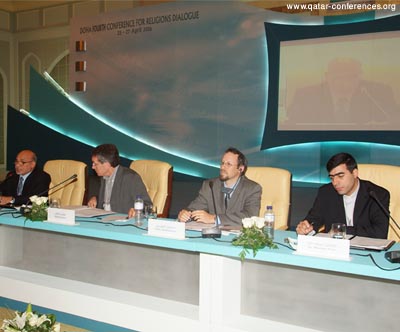
What can be accomplished in a religious dialogue? The conference itself, comprised of 130 Muslims, Christians, and Jews, mostly men, and mostly from the Middle East and Europe, was like many such events – dry speakers going well over their allotted time, speaking at a pace that the translators can not keep up with. One exception to the dry talks was the Imam from Denmark who had stirred up anger around the cartoon depictions of Mohammed. He pounded his fist on the dais and sprayed a fine mist onto the microphone. But there were moments in the conference that were unexpected. First off, the lead organizer from Qatar University, the Dean of Islamic Law, was a woman. Fully covered in a long-sleeved black dress and traditional headscarf, she moderated the opening panel with great civility and a touch of humor. Given that so many inter-religious events in the West are moderated by men, it was refreshing to be in the Muslim world and see her face on the jumbotron behind the dais.

Another highlight came during the session moderated by Rabbi Mirsky. After the session, a Palestinian participant asked when the “genocide” against the Palestinian people would come to an end. Mirsky tried to clarify the question, but the man yelled out, in English, “there is no Israel. It is Palestine! It has always been Palestine! Israel is the name of a prophet! The country is Palestine!” Mirsky attempted to raise the fact that there were many names, “it is also called Terra Sancta,” he remarked, but he was interrupted again “It is Palestine! There is no Israel!” A number of Palestinians and sympathizers erupted in applause, cheering the “There is no Israel!” cries on. A British Jew, Sidney Shipton, yelled out in what sounded like a House of Lords sound-bite “Would the gentleman please recognize the chair!’ but this only made the tension escalate. I was ready to run for the door. Was the conference about to turn on us? It wasn’t until one of our Qatari hosts intervened that I could breathe again. “We are not here to discuss this matter.” He said. “This is a conference on religious dialogue.” Afterwards Rabbi Mirsky made a noble attempt to speak with the Palestinian who had instigated the incident. It did not get very far.

But other exchanges did help us to understand one another, and speak in ways that transcended the usual political discourse. Matalon’s speech on the religious response to globalization was widely praised. I was asked to speak on environmental issues, and even the Palestinian who responded to my speech with a laundry list of Israel’s environmental crimes was willing to recognize that the only peaceful future for Israel and a potential Palestine is dependent on agreements on water and close cooperation on other environmental issues. In the hallway we shared a cup of coffee. Rabbi Fuchs–Kreimer ended the conference with an inspiring conversation with a Saudi woman professor who directs a center for domestic violence. In these moments of authentic dialogue and exchange we went beyond the formalities and met one another with open hearts.

What did I learn from traveling to Qatar? It occurred to me that Doha may be the new Geneva. The Emir, Sheikh Hamad bin Khalifa al-Thani rules a country whose citizens are devout and conservative Muslims, but he has already shown an interest in opening up to the wider world and acting as a bridge builder between rivals. His interest in religious dialogue, supported by the foreign minister, and by the Emir’s pioneering wife, Sheikha Mozah Bint Nasser Al-Missned, is part of a wider strategy of engagement with the outside world that includes investment in American universities and investment in environmentally friendly technology. For these advances, the Qatatri leadership has been criticized by those in the Arab world who despise the West; criticism that will only escalate now that they have publicly recognized rabbis from Israel. They will most likely be labeled ‘Zionists,’ which would probably make them the only Zionists on the planet who side with Iran in supporting the Hamas-led PA.

On the last day of my stay in Qatar, after a grueling squash match with a young Pakistani Muslim scholar, I ran down to the beach by our hotel and jumped into the Gulf. Looking out over the oil rigs in the distance, treading water, I felt that perhaps Qatar will not only be the place where liquefied natural gas is mined and major business deals are inked. Perhaps this may be the place where a wealth of natural resources will be translated into wealth of human advancement – educationally and environmentally. If the Emir continues on his path to openness, there is hope that Qatar will be the place where enemies meet and peace treaties are signed. Inshallah.


Rabbi Daniel S. Brenner directs the Center for Multifaith Education at Auburn Theological Seminary in New York City.

16.5.06

I-I-I- am calling You-u-u


Today I became a member of an 'outreach advisory board' for the new doc called The Calling by Daniel Alpert. Alpert's brilliant idea is to track a few students over three years or so as they become religious leaders. So far, he's followed a young Pakistani Imam-to-be at Hartford Seminary, a Latino Theologian (I wrote Novice earlier - out of ignorance - my apologies Steven) at a Catholic seminary in San Antonio and a guitar playing rabbinical student at JTS. He'll add more as the project goes forward. While the seminary students will not meet or interact with one another - I do like the fact that Alpert is tracking them at the same time, and envisioning weaving the stories together - if it works.

9.5.06

Art Green, Fiedlston, Gus Neibuhr....

I'm still waiting to hear if the Jewish Week is running my essay on Qatar - so please stay tuned! So in other news....I sat in on a brilliant talk by my former teacher Rabbi Dr. Art Green whis weekend at Montclair's Shomrei Emunah. Green spoke about the Zohar, and the idea that the sexualized feminine imagery of the mystics is a counter-narrative to the cult of Mary in Spanish Catholicism. Then Kabbalists in Turkey form a counter-narrative to the Sufis - fascinating idea. Green was mesmerizing - he spoke for over an hour and I was riveted by every word. (The last time I heard him speak for an hour was under a Chupah ten years ago when Lisa and I were married by him!) His best idea was in a discussion afterwards - Elohim is truly a flipped word - Mei - Eyleh -- meaning "Who?" and "These" the "Who?" is the 3 sefirot that are unknown and the "These" are the seven known sefirot. He also spoke on Hillel Zeitlin - who I've been thinking would make a good subject for my next play.

This morning I spoke (with Katharine Henderson and Nurah Amatullah Jeter) at the Ethical Culture Fieldston School at an assembly on the Holy Land -I spoke about the Tower of Babel, Abraham, and Exile...basically the idea of 70 nations, Jewish homeland, and the problematics of exile. The students were really sharp - they asked great questions.

Finally, tonight is our Rudin Lecture - please feel to drop by at 5:30 if you are in NYC. Here's my invocation:
The ancient words of the Book of Proverbs remind us:

Wisdom rests quietly in the heart of the judicious (Proverbs 14:33)

We come together tonight, people of many faiths, to set in our hearts a bed on which wisdom may rest.

There is an old Jewish folk tale on wisdom -

Wisdom enters the world and walks from village to village. But each person who sees wisdom is afraid. ‘Wisdom is ugly’ they say. ‘Wisdom is dirty’ they say. Wisdom is ‘sick’ they say. Everyone runs from wisdom. People go out of their way to avoid wisdom. Wisdom is broken-hearted. Wisdom floats back to the heavens and comes before God in tears.

“No one wants to see me!” Wisdom complains.

God answers: “When you go out into the world, dress yourself in a story.”

Tonight, we come together to hear from a journalist and a scholar, one who searches for stories, and teaches others where to find them. May we, in our discussion, share stories, and learn to welcome wisdom into our hearts.

25.4.06

Letter from Doha


I write from the exquisite conference center of the Four Seasons hotel in Doha. In the hours before the conference began, I swam in the Arabian Gulf, played squash with Saeed Khan (a Pakistani Muslim who now lives in Detroit) went Oud shopping in the shuq with Rabbi Roly Matalon, and watched a few Arabic music videos on one of the two 54 inch plasma screens that adorn the massive room that the Emir has graciously set aside for me to rest my weary bones.

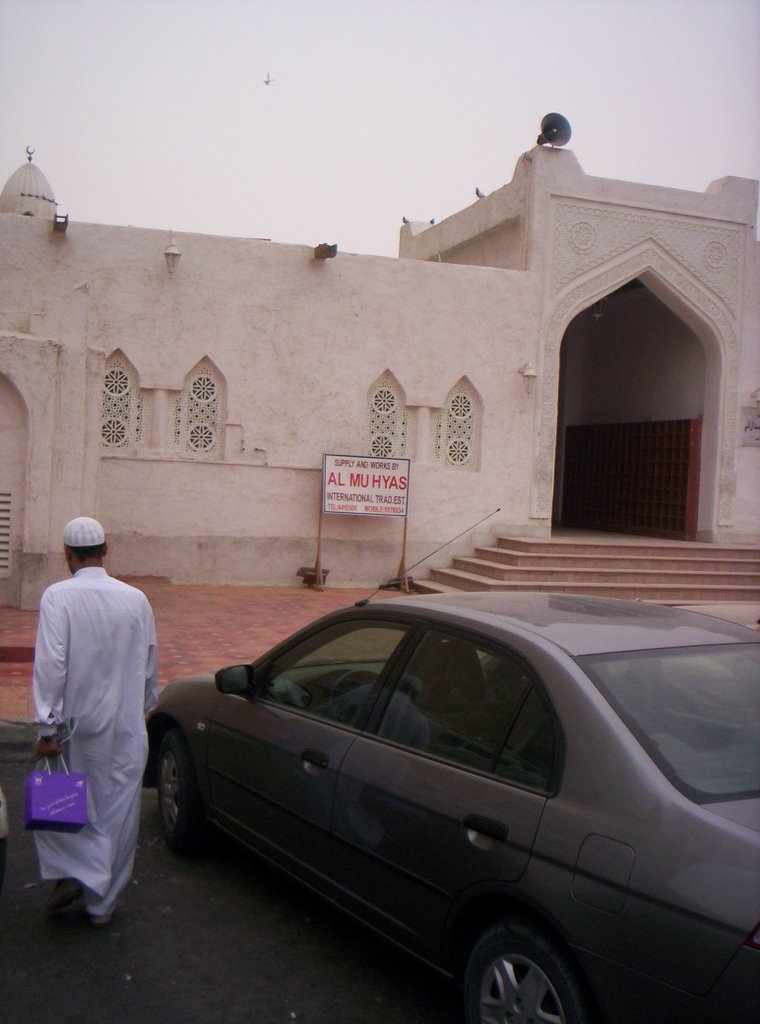
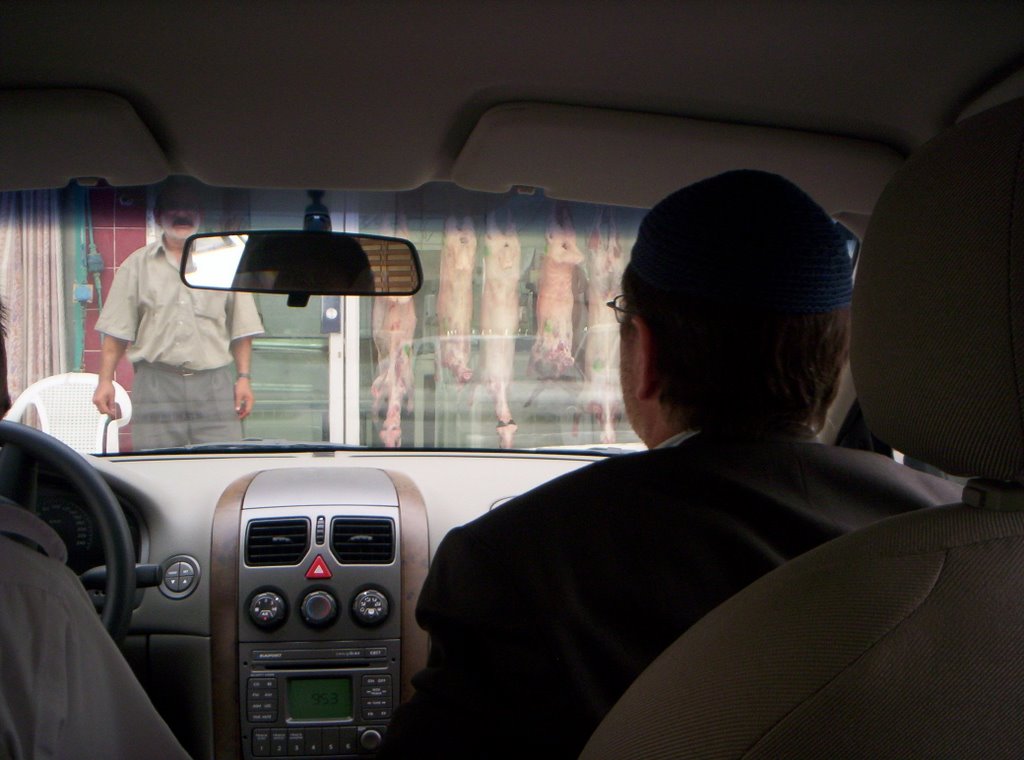
The trip to the music shop was typical - our Phillipino driver parked in front of a butcher shop with sheep carcasses hanging out front, we first walked into an Arabic music/cassette tape shop and the proprietor had no idea where to go. We then asked a guy selling electronics and he told us to go up a couple of blocks. We passed by a number of leatherworkers who sat on the street corners. There were many textile shops and women in full burkhas walking in and out. In lieu of traffic lights, the street corners have men in beige uniforms on platforms directing the flow. A traffic official waved to us and yelled out "Welcome!" smiling widely as we ran across the dusty intersection. When we finally made our way to the oud shop, the Ouds were all Egyptian made, and $700. Roly played one and I took a few photos and we headed back to the car.

Doha is one massive construction zone. There must be fifty high-rises going up - there are workers in green uniforms everywhere - taking periodic breaks to bow to Mecca. The new buildings are an eccnetric mix of moorish and modern - they are trying to create a new Islamic architecture here.

The conference kicked off with the minister of foreign affairs - and three speakers representing what the moderator referred to as 'the divine religions' More on the conference later.

Afterwards, I had dinner with Chase Untermeyer, the U.S. Ambassador. He was appointed here by George W two years ago - he was George HW's assistant when when HW was the VP. The guy was fascinating - He was born in the Garden State but was raised in Texas, German Jewish father, agnostic mother - after getting back from Vietnam he got into Republican politics, he served a short stint as the head of Voice of America.

I ended the day with a stroll through the palm tree lined hotel grounds with a young Imam from Malawai, talking about who is ready for democracy and who isn't.

More to come.

23.4.06

Off to Doha

Dear readers,

I'm leaving for Doha tonight - to speak at a religious dialogue conference. Here's a draft of my speech - which may go through some changes in flight....I'll update on my return.

Daniel


Inter-religious Dialogue and Environmental Protection

Doha Conference on Religious Dialogue
April 26, 2006

Address by Rabbi Daniel S. Brenner
Auburn Theological Seminary - New York City

I begin with words of prayer from Psalm 148:

Exaltations to the Holy One! Mountains and hills, fruit trees and all cedars, wild animals and all cattle, creeping things and flying birds, give thanks to God!

First, my gratitude to His Highness the Emir of Qatar. Your openness to religious diversity and dialogue is an example to all world leaders. Your vision to initiate this gathering is commendable, your commitment to sustain it is deserving of praise. And now I understand why so many say that your hospitality is unrivaled. I also wish to thank those on the faculty of the University of Qatar and those who work for the embassy of Qatar and all others who have made it possible for this extraordinary event to take place.

My thoughts today are drawn, in part, from the reality that the beautiful body of water whose shores we are on now has suffered great ecological damage, mostly due to the spills and fires produced by wars between nations. While the Gulf continues to recover, the only thing that will insure its return to health will be peace and stability in the region. May God bless His Highness with the patience and wisdom to carry out his vision of Qatar being the place where enemies reconcile and new relationships are born.

As a child growing up during the tail end of the cold war, I often had nightmares of the mushroom clouds and the radioactive rains of a thousand Hirsoshimas. In the summer, when I would accompany my father to synagogue to read the Book of Lamentations, ascribed to the biblical prophet Jeremiah, I would hear a slow sad chant of the destruction of Jerusalem

Those who feasted on delicacies perish in the streets;those who were brought up in purple cling to ash heaps. (Lamentations 4:5)

I would imagine such a destruction ripping through suburbia. And I would dream of a getaway plan.

How could one escape such a nuclear disaster? A disaster that would make large parts of the earth uninhabitable?

It seemed like there were two options – either sail-off to a remote island off the coast of Chile or jump aboard a giant rocket propelled spacecraft – a modern Noah’s Ark – a genetic lab of all that lived on earth, and head out into space. In either place, I imagined, we few survivors would start a new life and build a utopian community.

The science fiction answer to environmental devastation – either devastation wrought by world war or wrought by the power of one mutant virus – seems like the twenty-first century’s preferred mode for escape. As we sit here now, up above us the International Space Station is orbiting. Anthropologist John Moore estimated that it would take only 160 humans to preserve the human species in space for centuries until they can repopulate earth. Unfortunately, the entire crew of the International Space Station is currently all men.

The Space Studies Institute has identified the number one priority for future space colonization to be the perfection of a totally closed environment life support system. Biosphere 2 in Oracle, Arizona, brought together the world’s leading scientists to do just that. They spent over 200 million dollars to build a 7,200,000-cubic-foot sealed glass and space-frame structure containing 5 biomes, including a 900,000-gallon ocean, a rain forest, a desert, agricultural areas and a human habitat. They succeeded in creating a giant sunny airtight warehouse where nothing can breathe or live. It will now be modified and turned into a conference center.
A space colony that operates independently of earth is not in the foreseeable future. So the other escape seems more compelling. The escape away from the electrical grid – the escape backward – a return to a simple life of rudimentary agriculture and a smaller human population. The leader of the animal rights group People for the Ethical Treatment of Animals, Ingrid Newkirk, argues that "Humans have grown like a cancer. We're the biggest blight on the face of the earth." Apparently in the developed world, people of my generation are listening to her – and they are not particularly interested in having children. This is especially true in Italy, Japan, Germany, the Czech Republic and Austria where birth rates are falling below death rates. Those on the most extreme end of the environmental movement who say that our ultimate goal as a species is to reduce our human numbers 400-fold. I wonder: Who gets chosen to have children? Who decides? It sounds to me like a veiled plan for forced sterilization and indirect genocide.
What does all this have to do with inter-religious dialogue and environmental protection?

It seems to me that the role of religions leaders at this hour, especially the role of those of us in monotheistic religions, is to say loudly and clearly that there is no escape from our responsibility towards the natural world – there is no escape to outer space or to forests in far corners. In the words of the Psalms we Jews sing each Sabbath, “the Heavens are for God, and the earth is given to the children of Adam.” Heaven may be an unpolluted garden of delights – but God has instructed us to take responsibility for the earth right here and right now, to work together to harness the best of what technology offers us and to utilize our own self-control to reduce waste and promote sustainable development. This should be the top priority for inter-religious dialogue. I commend all those who planned this conference for putting it on the agenda.
Our seminary runs an educational program for young people – Christians, Muslims, and Jews – entitled Face to Face/Faith to Faith. The students come from Africa, Europe, the Middle East and the U.S. In the summer, when they come to New York, I ask these young people the question: “If you think that we are learning from history and that the world is becoming a better place to live, would you please raise your hand?” Very few hands go up. This, my friends, is a serious concern.
When I was a child, I would travel with my family to the tropical climate of Florida to visit my grandparent’s home. In the back yard were magnificent orange trees and grapefruit trees. Each morning my grandfather and I would go out back, pick fruit, and squeeze juice for breakfast. When he became sick and died and eventually my grandmother had to sell the house, the first thing that the new owners did was to chop down the trees and build a parking lot.
In my heart, my grandfather’s death and the death of the trees are inseparable. The story is a parable about what we in the developed world have done to the forests of the planet and the people of the developing world in the last generation. Young people are very aware of this destruction. And they are looking for religious leaders who are willing to be a voice that reminds government and business leaders of our responsibilities to the earth.

One of the other things that I have learned in working with the teenagers of the Face to Face program is that as the world becomes increasingly commercialized, the spiritual thirst grows. While religious extremists quench this thirst with visions of global domination and social purity, we who believe in human progress must foster a vision that sees diversity at its heart. Diversity not simply in the marketplace – but diversity in terms of the books one can find in the library, cultural diversity, religious diversity, and beyond. There is no better model for this diversity than the bio-diversity of the planet.

A teaching from the sages on the Book of Ecclesiastes:

In the hour that the Holy Blessed One created Adam, the first earthling, he took him and let him pass before all the different species of trees of the Garden of Eden. The Holy One said: “See my works, how fine and excellent they are! All that I have created, this has been done for your life. Reflect on this, and do not corrupt or destroy My world, for if you do, there is no one to straighten it up after you.” (Kohelet Rabbah 7:28)

The spiritual path is the path that follows Adam’s footsteps – to walk the land and pass before each species of tree in awe and gratitude. God intends us to understand bio-diversity and to protect bio-diversity. From the Tower of Babel story we learn that God does not desire that we speak one language, or that we form one empire. God desires diversity.

The first step in an inter-religious dialogue on environmental protection is often a simple acknowledgment that there are sources within each of our traditions that guide us in understanding our responsibility to protect and preserve the natural world. When we share these stories across religious traditions we are supporting one another in the shared work of protecting the planet. I want to conclude with what I believe to be two other critical steps.

The second step in inter-religious dialogue on the environment is that we build a bridge between religious leaders and those in the scientific community who are working to address ecological concerns. At Auburn Theological Seminary, we have been gathering religious leaders – Christians, Muslims, and Jews - to participate in a week long seminar which is lead by a biologist from Columbia University. We spend a day on cosmology and creation, a day on evolution and genetic mutation, and a day on the origin of human consciousness. In the seminar, science and religion are in dialogue, and we who are concerned with spiritual matters must turn our attention to the earth.

The third step is for religious leaders to work with government and business leaders to address the two factors other than war that are driving us to destroy the environment - poverty and wealth. Those who are poor strip the natural world for their own survival. Those who live in comfort are stripping the natural world for the sake of convenience and greater wealth. The ethical question we must ask is: Exactly how much of the natural world’s resources is one nation, one group, or one person entitled to use? What are the limits? What are the responsibilities of resource rich countries to those who do not even have seeds to plant trees? The United Nation’s Millennium Development Goals are a noble effort to respond to these questions. Each of us should publicly lend them our support.

I began this address with my fears about nuclear war and ecological catastrophe. I want to end with my hopes for inter-religious cooperation. My friend Rabbi Michael Cohen, works for the Arava Institute for Environmental Studies which brings Israeli, Palestinian, Jordanian and other graduate students together to study desert ecology. The students, Jews, Christians, and Muslims study stream restoration, sustainable agriculture, and issues related to the body of water that is called in English the ‘Dead Sea’ that lies between Israel, the Palestinian Authority and Jordan. On a walk with Michael, he laughs as he tells me “We are trying to bring the Dead Sea back to life.” But it struck me as a perfect metaphor for religious leaders and the natural world. Let us work together to restore life to the planet – beginning with the lowest point on earth and working our way skyward. Could there be any better way to praise the Holy One?

12.4.06

Over 2,000 Unique Visitors!


Thank you to all 2,000 plus of you who have stopped by Reb Blog!

Wishing you all a joyous holiday associated with eggs.

Love, Daniel

6.4.06

Passover Poem 5766


The Amphibian Haggaddah

This is the part of the seder when we close our eyes and imagine the Guangzhou Baiyun District Xinshi Xinye Plastic Factory.
We follow the cement steps to the third floor,
Climbing past the roar of giant machines on the first,
the huge exhaust fan on the second,
opening a beaten-in aluminum door to reveal a vast storeroom.
A room full of…..

“…and the frog arose and covered the land of Egypt" (Exodus 8:2)

the frog?
One big frog, Rashi says.
And the Egyptians hit that big ol’ frog
And it spewed out more frogs.
Guess it was a mamma frog.
And the more they hit, the more came out.
And I guess they couldn’t stop themselves,
Smacking that frog
until every inch of Egyptian land was wall-to-wall baby frog.

…full of frogs, freshly molded plastic green squeezy frogs with big eyes and cute froggy smiles. Wall to wall frogs, this room, all frogs except for one, one lone…

Commentators differed in their understanding of zefarde'im, "frogs." Many said it referred to a sort of fish found in Egypt, known as al-timsah in Arabic, which comes out of the river and seizes human beings.

One lone half frog-half piranha. A mutant frog, really. The first frog pulled from the mold, removed from the heat too soon.

A scary looking plastic froggy.

And this is where the story begins –
a well-meaning grandmother ordering a cute frog from the catalog
to place at her grandchildren’s seder table.
And guess which frog she gets?
Yeah, that’s right, half-piranha boy.

But this grandma is not your typical grandma.
She loves piranha frog.
She turns him into a center-piece,
sets a plate before him like Elijah.

And so on this plague we focus tonight,
the supposedly cute one,
the plague of mutation,
the plague of death leaping from the green waters of life,
the plague which makes us think twice about dipping our fingers into the wine.
Ribbit.

-Daniel S. Brenner

5.4.06

Speaking Truth to Pharoah


I was reading the fantastic blog Velveteen Rabbi and she had a link to a Radical Torah piece by Rabbi David Seidenberg on Passover and social responsibility. Since I did a text study on this theme a few years back, focusing on three midrashim from Shmot Rabba, I thought I’d share them below…


1) And...Moses...went out to his brothers and looked upon their burdens... What did he see? He would look upon their burdens and cry and say, "I feel so distressed for you. If only I could die for you. Their is no harder work than the work of bricks and mortar." And he would help them with their work, every one of them.

2) Rabbi Eleazar son of Rabbi Yose the Galilean said: He saw heavy burdens put upon small people, and light ones upon big people; men's burdens upon women, and women's burdens upon men; the burden that an old man could carry on a youth, and that of a youth on an old man. So he would from time to time step away from his retinue and rearrange the burdens, making believe that his intention was to be of help to Pharaoh.The Holy One said: You left your own concerns and went to look with compassion at the distress of Israel, behaving like a brother toward them. So, I, too, will leave those on high and those below, and speak [only] with you.

3) Another comment on "He looked on their burdens." He saw that they had no rest whatever. So he said to Pharaoh, "When a man has a slave and the slave does not rest at least one day during the week, the slave will die. These are your slaves. If you do not let them rest one day during the week, they will surely die." Pharaoh replied, "Go and do with them as you say."So Moses went and ordained the Sabbath day for them to rest.


And btw, here’s a few of my Passover musings over the years…

On Eggs http://www.juf.org/news_public_affairs/article.asp?key=2249
On History http://www.clal.org/ss59.html
On Freedom http://www.jewishbulletin.ca/archives/Mar02/archives02mar22-04.html

A Zissen Pesach to all!

Imams and Rabbis - Reunion

While I couldn't go to Seville for the 2nd Imams and Rabbis for Peace Conference (I was in Florida at the RRA Conference) it is great to see that the event is continuing, and generating some good press. On Engaging America, the piece that I wrote on the first congress is being featured along with some other press.

2.4.06

"Well" by Lisa Kron - a short play review

Last night I saw Lisa Kron's play "Well" - a play on Broadway about a Jewish girl growing up in Lansing, Michigain whose mother believes in two things: Allergies and racial integration. The piece was deeply funny - especially the part of her mother, played on stage by a woman seated on a Lazy-boy recliner. But more important than the inventive staging of what is basically a one woman memoir based show was the central idea -- the "through line" of the piece - Kron is conveying to her audience that we should not be talking about identities as if they are clothing. She first claims that people think that 'being Jewish in the Midwest is like being Christian with a layer of Jewish on top" then she says people think that 'being Black is like being White with a layer of Black on top' and then she says being sick is like 'being well with a layer of sick on top.'

The result of her symbolic layering of these identities is that she challenges us to think about the origins of prejudice - not by calling attention to acts of racial and religious prejudice - but by calling attention to the natural prejudice that evolves around how we discuss our health, around being 'well' - i.e. if we feel sick, we prejudice those who are well, if we feel well, we prejudice those who are sick. By starting with that which all humans share -anxiety around the 'am I sick?' / 'am i well?' question, Kron has created a powerfully humanistic piece of theater. Between Doubt, Well, and Bridges & Tunnel, Broadway is starting to feel like the theater world again.

23.3.06

RRA Convetion 2006


I just returned from the Embassy Suites Hotel in Deerfield Beach, Florida, a resort which recently was overrun by ninety-seven sandal wearing reconstructionist rabbis. It was the annual convention of the rabbinic body I am a member of – the RRA - Reconstructionist Rabbinical Association- and I had the honor of co-chairing the show with Rabbi Vivie Mayer, a colleague from Connecticut.

The highlight of the conference for me was watching the 87 year old Rabbi Jack Cohen (pictured here- thanks to Rabbi Shai Gluskin, from whom I stole this photo) who for over twenty years served as the rabbi of Hebrew University in Jerusalem (and is a founder of the reconstrucionist based congregation M’vakshe Derech in the Holy City) dance with his wife to the turntablist infused sounds of the Latin Jazz/funk band the Spam All-Stars. Two civilization were brought together to form what Rabbi Joshua Lesser termed a 'religious groovement.'

22.3.06

Working Films

Tommorow I'll be speaking to documentary film makers at a forum with Robert West, the executive director of Working Films - a documentary film collective that works on issues of social activism.

15.3.06

The Theological Seminary of the Jews


I spoke to the rabbinical school of the Jewish Theological Seminary this morning - an informal event entitled 'community time' in the Beit Midrash. I joined my colleague Katharine Henderson in a presentaiton on inter-religious work. It was great to meet Rabbi Eddie Feld - whose work I have long admired, as well as Rabbi Shapiro - a student of the Lubliner who is the resident Beit Midrash guide. He is in his eighties, at least, and speaks with a thick European accent - at the end of the session he shook my hand and said "The Jewish people do not talk religion from the 'kup' ! We do not do theology! In Hebrew, 'Rosh' means heart - not head - What do I know of God? Can I think the way that my cat thinks? That is what a Jew knows of God!"

14.3.06

Klez Dispeners


New Jersey's finest Klezmer outfit, The Klez Dispeners , rocked our purim bash last night at the String of Pearls. They had everyone, especially the kinder, up on their feet, dancing like extras in Fiddler.

8.3.06

Pharmacogenics


My piece on Pharmacogenics is up on THE NEXT BIG THINK site this week! (thanks Andy)


I imagine that very few people outside of the medical research community have heard the word pharmacogenomics — and I would have been one of those people if it hadn’t been for a man with a gnome-like beard named Bob Pollack. Pollack, a research biologist at Columbia University, recently taught a course titled “Evolution, DNA, and the Soul” at Auburn Theological Seminary — an attempt on the seminary’s part to train clergy and seminary students to respond to the intelligent design creationists with the language of reality-based science. “Every health insurance company CEO in America would love to get a DNA sample from you. Why?” asked Pollack, a liberal Orthodox Jew. “Because now that we have mapped the human genome, we can also get a fairly accurate picture of your longevity from DNA. You probably don’t want to know this information. But they do! And I fear what would happen if they do — especially what would happen to poor people and minorities, if this ever came to pass.” Pollack’s concerns about the possible abuses of DNA gathering are serious. But that does not stop him from championing DNA research. “At the same time,” Pollack continues, “it is true that genetic information unlocks new possibilities for treatment. The more we know of someone’s genetic history, the more we can tailor treatment for someone with cancer, AIDS, and a host of other diseases.” And this is where the lure of pharmacogenomics lies. Take a quick look at www.DNAprint.com — there you can purchase a simple test in which you send in a cotton swab of tissue from inside your cheek and for $219 find out what percentage European or Asian or Native American you are. On the same site, you can read about tests for ovarian cancer and heart disease. Chief executive officers of pharmaceutical companies might not want to see developments in pharmacogenomics in the short term. Their livelihood depends on many people taking their medications and treatments. DNA information will tell people that specific drugs will probably not work on them, and profits for drug companies will decline. But in the long term, those of us fortunate enough to have health coverage will probably all be flocking for DNA-based tests that tell us much more personal information about our fragility and mortality than we want to know and also point us to specific drugs tailored to our code. So why is this the Next Big Thing for Jews in New Jersey? I’ll posit three reasons. Click for more...

An Adar Video Treat

Thanks to the blog "Life-of-Rubin" I came aross this brilliant little film - A perfect treat for the month of Adar.

More than baked goods from Waldensians!

The Role of Religious Minorities in Pluralistic Societies:
A Conference Celebrating the Centennial of the American Waldensian Society
23-26 March 2006 -- Rutgers Presbyterian Church236 West 73rd Street, New York, NY 10023
Three days of presentations, workshops and events led by religious scholars and church leaders on the gifts and challenges of religious pluralism in Western societies.The Conference will offer Waldensian perspectives from Latin America and Europe alongside North American voices and experiences. The purpose of such juxtaposition is to foster reciprocal learning on the role of religious minorities in promoting dialogue and practices of justice in increasingly diverse and rapidly-changing social settings.Presentations will include speakers from Argentina, Uruguay, Brazil and Italy. Speakers from the United States will include:

Rabbi Daniel Brenner (Auburn Theological Seminary, NYC)
Rev. Dr. John Buchanan (Fourth Presbyterian Church, Chicago)
Dr. Euan Cameron (Union Theological Seminary)
Rev. Dr. Harvey Cox (Harvard University)
Dr. Heidi Hadsell (Hartford Theological Seminary)
Dr. Azza Karam (the United Nation's Regional Bureau for Arab States)
Rev. Dr. Jacqueline Lewis (Middle Collegiate Church, NYC)
Rev. John Vaughn (The 21st Century Foundation)

6.3.06

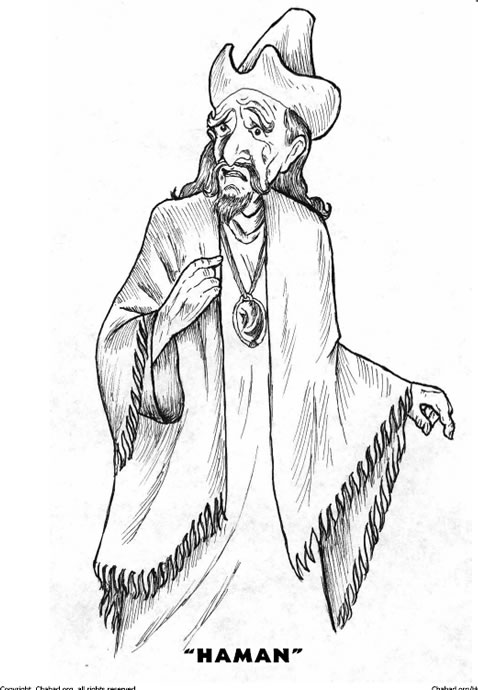
A Poem for Purim


Lynching Haman

Strange fruit
spoon dolloped
into the floury center
of this soon to be folded over cookie.

Your ears,
We rip from the side of your head and chew,
Tyson-Holyfield ritually re-ineacted.

There are songs about the hat
you once purchased from Shushan’s finest haberdashery
If it didn’t have three corners, would you have, indeed, chosen more of a beret?

We erase your name from our files.
Delete.
We shout it down.
We write it in chalk on the bottom of our Florsheim’s and we stomp.
It is great fun.

your limp body on a rope
let us rejoice!
light and happiness!

We should have warned you that in our literature all evil-plans backfire.
But then again, you should have known that every Jew fights an internal civil war.
When vengeance wins, we celebrate with either cookies or donuts.

1.3.06

Shinto Priests


Konee-chee-wah!!!!!!!!!!!!

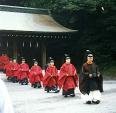
Next Friday morning, the State Department is sending over thirty Shinto priests from Japan. Few of them speak English - so I think I'll do a few chassidic stories for them and teach a niggun. I'll bring my digital recorder. Wish me luck. More later.

23.2.06

More on the immigration debates

The New York Daily News has got another strong piece on the immigration bill.

From the piece:

Tancredo is mad. And his rage is truly ecumenical. He is equally angry at the Catholic, Episcopal, Evangelical Lutheran, United Methodist and Presbyterian churches, and the Hebrew Immigrant Aid Society. For the Colorado politician, these religious groups, by trying to inject desperately needed compassion and common sense into the immigration debate, are putting national security at risk.

But the fact is that for an effective immigration policy to be possible, the shameless use of national security as an excuse to carry on anti-immigrant agendas must stop.
"Our policies should have compassion for those who come here to escape the crushing indignity of extreme poverty or persecution," Rabbi Daniel Brenner has said. They should also recognize that illegal immigration is a function of supply and demand in the U.S. labor market. And that as such, no law that limits itself to the enforcement of greater border controls will ever solve the problem. McCain is one of the sponsors of the McCain-Kennedy Secure America and Orderly Immigration Act of 2005, now before Congress, that is supported by the religious groups that make Tancredo angry.

Divan Cameo

Lisa and I were at a show last night - the Kretakor Theatre of Budapest's rendition of Chekov's The Seagull (3.5 hrs, in Hungarian) and we ran into Pearl Gluck. Pearl, who spends alot of time in Jersey now that she teaches at Rutgers, informs me that my dreams of being a movie star have been realized. I have a cameo in the DVD special features of her film Divan. Now I can move into a run down mansion on Mulholland and drink myself into oblivion.

Wigwam, you are too tense....


Nineteen years ago, inspired by the words of the Western Shoshone tribal chief, I trespassed onto the Nevada Nuclear Test Site and found myself in handcuffs. I was a college student in need of a haircut in the hands of a Nevada police officer with a buzz cut who escorted me to a makeshift stockade topped with barbed wire, then to a prison bus, then to a town jail in Tonopah. Rather than book me, he took off my cuffs, pushed me out to the sidewalk and told me “go back to where you came from.” I wandered over to a local pizza restaurant, and thanking the Blessed Holy One for my freedom, ate one of the worst pies of my life.

read more in today's ol' opinion column of the Jewish Week. I connect a few dots between Mordecai Ben Noah, Jack Abramoff, and a place we call in Hebrew 'Lat Vegat.'

17.2.06

buzzmachine

When I got started on Reb Blog, I basically thought of it as a good way to post articles in print media that I published, or got quoted in, or speeches that I gave up for public viewing in an ongoing way. It would be a vanity press-like journal of my work. Now I'm beginning to think differently about what a Blog is for. A few years ago, I got to meet Jay Rosen, an NYU journalism prfoessor who had just written a book called "What are Journalists for?" Yesterday I got to sit at the feet of (and enjoy a lemonade at the Princeton Club with) Jeff Jarvis of Buzzmachine . Jeff is the brother of Rev. Cindy Jarvis who I worked with on confronting the Messianic 'synagogue' drawing money from the Presbyterian new church development funds. Jeff spoke enthusiastically about how the new blog media is changing the print media - and changing network television. Blogs work, he argues, not by being the top overall blogs - i.e. the article in New York magazine about the top fifty blogs is irrelevant - but by being the top in a particular niche. For example, the top cooking blogs represent a larger and more engaged audience than Emril Legasse. Each niche - media, religion, tv, NASCAR, crochet, lacrosse, whatever will eventually spawn into podcast and video broadcast that will rival whatever the FCC approves or what cable providers want to sell us for $99 a month. They may not replace the big media anytime soon - especially as big media begins to eat them and acquire them - but they may usher in a new, more democratic, way of generating news and commentary on the news. Bloggers in Iraq, Jeff argues, are changing the way we view the war. We can now draw from personal experience, in a 'human' way - not a slick tv product - and we can hear new voices.

Once again, the guide atop this blog, Rabbi Kaplan, was prophetic. He saw the force of democracy as one which would insert itslef into all institutions, particularly religious institutions and cause transformations that would spawn new entities and new 'civilizations'. The more I have recieved emails from other bloggers, and I have learned from reading other bloggers, the more I see the blog world as a democratizing entity.

12.2.06

Video Games, Comic Books and the Holocaust

Last Thursday night I flew up to Toronto and delivered a speech to about 85 teachers at a symposium on 'Popular Culture and the Holocaust.' My address, titled The New Killing Fields: Video Games, Comic Books, and the Holocaust is accesible by clicking here. (too long for the blog!) There were teachers from quite a few Catholic and other Christian schools, Jewish day schools, and public schools. For a vast majority of them this was there first experience with 'historical' games on the X-box. I played Return to Castle Wolfenstein and Prisoner of War, projected on the wall of the conference center.

6.2.06

Jewish Perspectives on Immigration

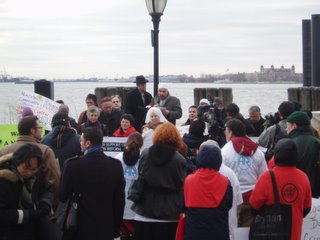
Jewish Perspectives on Immigration

Rabbi Daniel S. Brenner
Delivered February 1, 2006
New York Immigration Coalition Inter-religious Rally
Battery Park, New York City

Before I say a few brief words regarding Jewish teachings on immigration, I want to say that today I am standing on what is for me and my family sacred ground. It was on this spot that 100 years ago, my late grandfather, Herschel Brenner, then a six year old boy from Częstochowa, Poland began his new life. I often imagine that family of nine, in a small Brooklyn apartment, my great grandfather working a job as a stone cutter in the monument business, learning a new language, becoming Americans.

For Jews in America, any reflection on immigration must include the tale of the S.S. St. Louis a ship of 937 Jews fleeing Nazi Germany in 1939 that was not welcomed into American or Cuban ports. The boat returned to Germany where most of the passengers were eventually murdered by the Nazis.

A Jewish perspective on immigration policy begins with the biblical command:

"Do not stand idly by while another's blood is being spilled" (Leviticus 19:16)

Today, as war and famine continue to lead strangers to these shores in search of protection and asylum, we must be mindful of the need for a safe haven.

There is a classic Jewish joke on the topic.

It is the beginning of the Nazis rise to power in Germany and a Jew from Vienna, desperate to find a safe place for his young family, gets an appointment at the visa office.

“Where to?” the visa officer asks.

The Jew does not have an answer.

The officer points to the globe that sits on the desk. The Jew spins the globe, meditating on each continent and each country.

“Well, where to?” the officer says.

Finally the Jew replies:

“I hate to bother you, sir, but do you have any other globes?”

But the notion of a safe haven is only one of the teachings on immigration that has strong roots in the Jewish tradition.

The classic Biblical text on how we are to act towards those who come into our land from other lands is cited in the interfaith statement. Leviticus chapter 19 verse 33-34:

33 "When an alien resides with you in your land, do not harass him.
34 You shall treat the alien who resides with you no differently than the natives born among you; have the same love for him as for yourself; for you too were once aliens in the land of Egypt. I, the LORD, am your God.

But it is an oversight to read this verse without reading the two verses that follow it

35 "Do not act dishonestly in using measures of length or weight or capacity.
36 Just balances, just weights, a just measure for flour, and a just measure for oil, shall you have: I am the LORD your God, who brought you out of the land of Egypt.

Why is a law about strangers followed by a law about honest measurement in the marketplace?

Because in order to create a society which treats the alien as the natives are treated, we must begin by creating a just, transparent, economic system. One which does not cheat immigrants, one that does not create a second class of citizens who must hide in the shadows for fear of imprisonment and deportation.

The biblical laws were very clear – if one lived among you and followed the minimum ethical standards- the Noachide laws- then it was a responsibility to treat that person
with the same love and concern that we treat our other neighbors.

Today we are most concerned with the way in which the proposed legislation, the Border Protection, Antiterrorism, and Illegal Immigration Control Act, goes about enforcement.

Andrew Grove, a Jewish survivor of Nazi Germany, wrote last week (1/26) in the Wall Street Journal:

The bill contains a provision punishing anyone who "assists, [or] encourages . . . a person who . . . lacks lawful authority to remain in the United States" to remain here….
This could change the nature of our society in a way that I have seen firsthand. As a Jewish child hiding from the Nazis in Hungary, I saw how the persecution of non-Jewish Hungarians who hid their Jewish friends or neighbors cast a wide blanket of fear over everyone. This fear led to mistrust, and mistrust led to hostility, until neighbors turned upon neighbors in order to protect themselves. Is this what we want?

We are a nation that respects the rule of law. But we would be wise to remember the teaching of the 18th century Chasidic Rabbi Simcha Bunam. He asked the question - Why in the verse in Deuteronomy 16:20 does it say: 'Justice, justice shalt thou pursue'? Isn’t it enough to say the word once? It repeats to teach us that we may use only justifiable methods even in the pursuit of justice."

Today we are here to send a message to the Senate and the White House. And in particular I would like to address our President.
Mr. President, in January of 2004, you said:
“Over the generations, we have received energetic, ambitious optimistic people from every part of the world. By tradition and conviction, our country is a welcoming society.”
And last night you emphatically stressed the contribution of immigrants to this nation.
But until the words terrorism and immigration control are detached from one another then we are not creating a welcoming society. In fact, the moral failure of the Border Protection, Antiterrorism, and Illegal Immigration Control Act lies in the very title of the bill. There should be a moral outcry whenever the ‘terrorism’ and the word ‘immigration’ are used in the same sentence. There is a great irony here - the two men who crashed planes into the Twin Towers came to the U.S. legally, on tourist visas which were extended to student visas. But the roughly eight million women and men who could not afford to come here legally are the ones who face a society of suspicion, and the threat of detention and deportation. These women and men are praying that they will simply be allowed to work and feed their families without being labeled as felons.
Mr. President, senators, direct your heart to theirs, have compassion for their prayers, help us all, as a nation, to act humbly, love kindness, and walk with God.

Daily News Coverage

Check out The New York Daily News - a forceful commentary by Albor Ruiz on the immigration legislation that is headed to the U.S. Senate.

From the piece: "The Senate will discuss the bill this month, and hopefully smarter, cooler heads will prevail and reject it. This is an unbelievably bad piece of legislation that, despite the hype, does nothing to make the country safer or to fix the broken immigration system.
"We have come to a point where we allowed fear and suspicion to overwhelm our judgment of what is moral and what is immoral," said Rabbi Daniel Brenner on Thursday. "Our policies should have compassion for those who come here to escape the crushing indignity of extreme poverty or persecution."
Obviously compassion was not in the minds of those who drafted and sponsored this bill."

1.2.06

Letter from Scotland


I just recieved a letter from a woman who works with the Liberal Jewish community in Edinborough - and she sent me her speech at the World Disarmament Campaign. She deploys the kaddish translation I penned a few years back in a lovely way.

Talk given at the World Disarmament Campaign interfaith occasion 29 Jan 2006, on behalf of ELJC.
This is the first time Judaism has been represented by our community at this annual event. Other faiths represented were Christianity, Baha’i tradition, Buddhism, Hinduism, Islam. (The invited Sikhs were unable to attend).
Catherine Lyons
‘Swords into Ploughshares’
This Jewish prophetic image has come to symbolise Christian peace activism. I’ve been mulling over what it signifies in a Jewish context.
Micah and Isaiah’s vision of universal peace and justice for the future sits side by side with, and I believe arises from, their criticisms of social injustice and awareness of political instability in their own time.
We cannot imagine what peace and justice can really mean if we don’t engage our full attention with the world as is it now, and recognise injustice when we see it.
This contrast reminds me of Kaddish, a prayer of mourning in Aramaic, and how Jews use it. Bereaved Jews say Kaddish according to particular ritual procedures, and usually we say Kaddish for a particular person, a close family member.
And yet the prayer itself doesn’t mention death, or even encourage reflection about the person who has died. In the midst of their grief, it enables mourners to affirm to their community the greatness of God, with nothing less than exuberance, and it wills the coming of universal peace.
In the world we live in, lives are cheap; so may disempowered people have been killed in the last year, the collateral damage of territorial disputes and global power struggles, or they have simply failed to stay alive for lack of basic human resources, their extreme poverty the collateral damage of a violent global economy.
They are mourned by their families, such families as remain, sometimes bruised again and again by relentless war and poverty. Here in comfortable Edinburgh, we cannot meaningfully say Kaddish for them. But I am going to read you a translation of Kaddish, by Rabbi Daniel Brenner, together with his introduction to his translation. Rabbi Brenner is director of the Center for Multifaith Education at Auburn Theological Seminary in New York and a reconstructionist rabbi.

The translation that I am presenting here is an attempt to put the kaddish into plain English, colloquial, slang, street, to translate it the way it might be spoken. In translating it this way, I hope to capture the desperation and heartbreak, and the hopes for peace and restored order, that I see reflected in its words.
A Kaddish
Make the God-name big.
Big and holy.
Do it in this world,
This creation sprung from consciousness,
And bring some order to this.
Do it fast, soon, in our lives, in the days ahead, in the life of the people we call home.
Everybody join with me: May the name be blessed forever and ever!
Yes, blessed.
Blessed, whispered, sung out, shouted, honored, this holy name.
The name is beyond any song, poem, or comforting words we could ever speak.
Eveybody say: That's the truth!
May a big peace descend from the heavens, a life-giving peace for all of us, for our beloved people,
Let everybody say: May it be true!
Make that peace in the heavens, great peacemaker, great One who brings wholeness to our people.
Stop.
Everybody pray: May it be true.

31.1.06

Words of prayer for tommorow's rally in Battery Park

nu=3237>6<8>256>WSNRCG=32334;85<7874nu0mrj.0.jpg">
New York Immigration Coalition
February 1, 2006
Battery Park, NYC

Invocation

Blessed Holy One, we know you by many names and we call you by many names in many languages, but at this hour of moral concern we call out to you with one voice.

Protect us as we protect America’s values. Shield us as we shield our nation from a culture of fear and suspicion. Guard us as we guard the rights of women, men and children to live in a land of religious freedom. Strengthen us as we fight for the rights of families to live and work without harassment. Guide us as we aim to reunite families across borders.

Eternal One, remind us to listen humbly to each story of immigration. The stories of the first people who crossed the Bering Strait into this land. The stories of forced immigration. The stories of fleeing from persecution. And the most common of all, the stories of those who have come to these shores to avoid the crushing indignity of extreme poverty. Teach us to listen compassionately to all the stories that surround us without judgment.

To you, to the One our ancestors cried out to, we cry again today. We cry for a world that has been drained of trust due to the actions of a few self-destructive men. We cry for a world in which limited understanding of language and culture has lead to unnecessary social divisions. And most of all we cry for those in this land who are silent, not visible, those who fear even to lift up their voice. May the prayers in their hearts be heard at this hour.

Source of life, we place ourselves before you. May we be vessels for righteous teachings, and may our voices be heard throughout the land. May you lead us to the day when we can join together to celebrate a careful and compassionate immigration policy in our nation.


- Rabbi Daniel S. Brenner


An article on the rally appears in The New York Sun

25.1.06

The Pity Card

Short thoughts on the short film The Pity Card
Director - Bob Odenkirk

I would file Odenkirk's 12 minute film, playing at the Sundance Festival, next to the 'survivor' episode of Curb Your Enthusiasm, the 'tolerance museum' episode of South Park and Sarah Silverman's 'Jesus is Magic' as a prime example of the new format of 'post-holocaust' comedy -comedy that pokes fun of the sanctity of holocaust memory.

The film speaks to a particular post-holocaust museum/holocaust education paradox: The American Jew desires to be associated with the holocaust in order to recieve the empathy of other Americans - but also wants to be detached from the holocaust in order to be seen as 'normal.'

In Odenkirk's short film, he deploys the stereotypical hollywood couple - the nebischy Jewish kid trying to impress the dumb blond. (think Jazz Singer 1927) But instead of acting cool (i.e. Black) to get the girl, here the protaganist stumbles into a situation in which he realizes that pity - in this case his grandparents survivor status - can help him get the girl. After telling his all-American white boy sidekick about taking her to the holocaust museum on a first date, he sees her at a party. All is well when the young couple are in private, but when she begins to tell a group of friends at the party about how much she is learning about the holocaust and says 'isn't that right Simon?" he inadvertantly says "I don't fuc*ing care about the holocaust! Let's just turn on the music and have a drink and get drunk...." And thus, he loses the girl. In the end, he wins the true prize, friendship with the sidekick, who is, of course, trying to figure out what his pity card is - a difficult task for many a Southern White boy.

The film, which is well acted and shot, is funny. I laughed from beginning to end. But on reflection, I have to say that the depiction of the third generation of survivors is not convincing. When I think of my friends whose grandparents are survivors, what I've seen is not a diminshing of the emotional impact of the Shoah - but the exact opposite. Many survivors kept their anguish, rage, and despair bottled up in order to survive. Children of survivors are left deeply scarred - and the rates of depression and suicide are alarming. Their children, sadly, are impacted - often in ways that they only come to terms with in early adulthood. Perhaps the protaganist in The Pity Card is simply immature and clueless - and maybe he did not have a close relationship to the parent who was a child of survivors. But as much as I enjoyed this short filck, and laughed at the central premise of a guy who 'almost used the holocaust to get laid' I found it to be dishonest. Some people may be 'over' the holocaust - but those who were raised by children of survivors are rarely among them.

22.1.06

Cirque Eloize: Rain


About a dozen years ago, at a Pina Baush dance performance at Brooklyn Academy of Music, I had something close to a religious experience. It was hard to describe - but the dancers, encircling a massive pile of red carnations, created such an ecstatic movement of beauty and wonder and celebration that I felt as if I had entered a dream. A delightful dream. Cirque Eloise , the Candian company whose piece Rain I saw today in Princeton, just took me on a similar trip. The piece, which ended in a joyous chaotic childhood romp in a simulated rainstorm was breathtaking. Wow.

19.1.06

On Being a Multifaith Rabbi

(note: an edited version of this piece is published in the newsletter of the RRA)

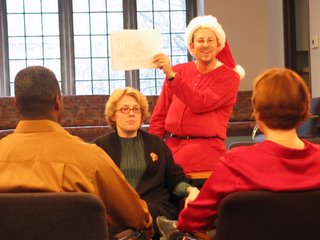
Working in a Christian Seminary, I sometimes feel like the wacky upstairs neighbor in a Hallmark Channel sitcom. Sure, Menachem Meiri and Yakov Emden respected Christianity – but would they have played Santa at the office Christmas party?

Inter-religious work has not changed much since its un-official birth at the 1893 Chicago World’s Fair. It is often a community relations exercise in putting aside differences with the religious other to further political goals. Other times it is done in the name of “understanding,” and you find yourself smiling at someone’s warped theological ideas as the word “nut-job” illuminates in a mythic neon sign above their head. Other times you find yourself the spokes-model for the Jewish people—and very earnest people ask you about oysters and salvation and foreskins and mezuzahs.

But thankfully, most of my work these days is enlightened by the emerging academic field dedicated to wrestling with the question “What is the point of inter-religious work?” Three folks worth a careful read are Paul Knitter, Miroslav Wolf, and Jonathan Sacks. They answer with the following goals: to uplift the voice of the suffering; to critique bellicose gods; and to respond to globalization’s dark side.

What I appreciate about these thinkers is that unlike the visionaries of the last century, they are wise to religion’s trump card. They push me to navigate the terrain between those who are fundamentalists and those who are not with great care. They remind me that inter-religious work changes in every generation.

As Reconstrucionist rabbis, I think that we have a unique contribution to multi-faith work – and I’ve seen Kaplan’s concept of evolving religious civilization help leaders of other religious traditions to navigate revelation and reason. But I also sense that we have something unique to learn from this work. As rabbis who have a tendency to value doubt over faith, multi-faith work is often a healthy corrective to cynicism. A Zen master who told me ‘after a few years you move beyond the pillows’ reminded me that long-term faith commitments matter. As Kaplan’s notion of “peoplehood” is challenged and Jewish fundamentalism grows exponentially, it may be time to consider the role that faith, discipline and devotion can play in the lives of progressive Jews.

But ultimately, I think that the point of inter-religious work is, to quote Heschel’s No Religion is an Island, “to respond to the predicament of the here and now.” In Heschel’s world that meant Jews, Catholics, and Protestants speaking out against systemic racism with a unified, prophetic voice. Today, we need to do even more island hopping – and to do so in a world which is veering towards ecological implosion. And since we, as a rabbinic body, have racked up some serious inter-religious frequent flyer miles, I hope that we will chart the course ahead – or at least be put in charge of the in-flight entertainment.

Punya Tithi = Yarzeit


I just got a wonderful invitation from the Indian consulate. The event, January 30th, is the 58th anniversary of Mahatma Ganhdi's Punya Tithi. There will be a program of bhajans (devotional songs) and inter-faith prayers. More later.

15.1.06

Joseph Loconte

Back on January 2nd, Joseph Loconte had a piece chastising Liberals for using the language of faith in his “Nearer, My God, to the G.O.P.” which ran in the New York Times. Loconte, in an attempt to teach a wider lesson about faith and politics argues that “When Christians – liberal or conservative – invoke a biblical theocracy as a handy guide to contemporary politics, they threaten our national discourse.” This sounded perfectly sensible - until I did a bit of background Googling and discovered that Loconte is the same man who rallied support for the Iraq war by writing: "That’s why Jesus talked a great deal about punishment… a kind of ‘pre-emptive strike’ or judgment against evil might even be required." (NYT 1/28/03) I’m sorry, but you can not rally people for the war by arguing that Jesus requires us to punish Iraq and then start complaining when Democrats reach out to religious progressives to gain support for economic policies or environmental protections. Debating differing interpretations of God’s ideals for human behavior does not threaten our national discourse – it is our national discourse.

9.1.06

Evolution, DNA and the Soul

This week I'm studying with Bob Pollack, director of the Columbia University Center for the Study of Science and Religion. Here's more on the course. He is a fascinating speaker - and already making folks blood boil. We have a mix of religious leaders - Catholics, Methodists, Presbyterians, Unitarians - and we will all be going to the Darwin exhibit on Wednesday at the Museum of Natural History.

3.1.06

1,000 unique visits

Reb Blog has now been read by over 1,000 unique visitors! While in blog land this may not be such a wondorous feat, I am celebrating by posting a new poem. Enjoy:


The poetry hacker

The poetry hacker
beams his verse
to Tuscon
to an unsuspecting Blackberry user
why Tuscon?
I don’t know
But she doesn’t get it.
Delete.
But the text message
Wired to a random number in Istanbul
Is faithfully translated
Then read aloud at a house party
Spoken in broken English.

Our hero blogs late, sending emails to
.nz
.cz
.kg
He dreams of hacking the pentagon
Sending daily poems to missile silos
Down to the underworld
Where the button-pushers dwell
Sending a poem about
Crushing loneliness broken by a four word reply:
Thank you for poem.

2.1.06

The Onion


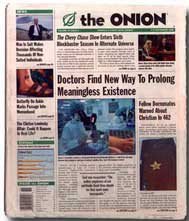
Back in 1987 and '88, when I was going to school in Madison, Wisconsin, I was part of the ensemble at the Ark Improv Theater, directed by Dennis Kern, a man who is considered a master of improv comedy. (He had previously trained Joan Cusak.) The Ark was a a gem - a transformed auto mechanic shop where I had the great thrill to perform on stage with the late comic actor and SNL star Chris Farley - and to hang out with some brilliant comic writers. One of them, Todd Hanson - who at the time was the college paper's best cartoonist and a convenience store clerk- went on to write for the satirical paper The Onion. Since then, the Onion has grown, and except for seeing Todd at our mutual friend Juan Avila's wedding, I have lost touch. So, on my last night in Florida, at my Aunt's house, I see that my 93 year old Grandmother, Flo Funt, has picked up a book and can't put it down. What is it? The Onion's latest publication - and all of a sudden I start thinking about Todd, the Ark, and what seems like another life.

28.12.05

Muckoseegee Reconstructionists


I snapped this photo on a recent airboat tour of the Everglades near Miami. Repairing damage done by Hurricane Wilma, these Muckoseegee tribesmen are reconstructing a Chickee hut on a small, gator infested island. While much has been lost as the tribe has shifted from fishing (mercury levels got too high) to casino gambling and NASCAR, it was great to see an ancient practice like Chickee building done outside the confines of the museum. My aunt Sorah, a Lubavitcher recently immigrated to South Florida, explained that they fold the palm braches in half and nail them down like shingles, slightly overlapping one another. Back in the day, they slept in the roof area (the rafters) to protect their children from the gators.

19.12.05

Christmas! Attack!

Twas the War On Christmas

By Daniel S. Brenner

Twas the war on Christmas, when all through the land
’holiday’ greetings of happiness were banned.
Christmas cheer was spread to Sikh and Hindu,
’Christ is Born’ cards sent to the ACLU.

The children were nestled all snug in their beds,
While visions 360 danced in their heads.
And mamma on her yoga mat, and I in my jeans,
Had just clicked on the TV for some more of split screens.

When there on the tube there arose such a clatter,
I sprang from my Sudoku to see what was the matter.
a long haired Galilean like from olden days
was wishing Americans ‘Happy Holidays’

The moon high above the new-fallen snow
projected his image on WalMarts below.
in vast parking lots appeared all sorts of peoples
the sort who sway hands under megachurch steeples.

He spoke without parable, in verse slow and quick:
’I think that you have me confused with St. Nick!
It wasn’t to bring more possessions I came,
but to glorify, dignify God’s holy name!

"Now O’Reilly! now, Falwell! now, McCullough and Gibson!
Now, Farah! Limbaugh! Now Coulter and Dobson!
To the pew you should go! To your knees you should fall!
Now dash away! Dash away! Dash away all!"

As dry leaves that before the wild hurricane fly,
these warriors for Christmas let out a cry.
they wept, they lamented, they let out a plea,
Didn’t we learn anything from watching the Passion DVD?

And then, in a twinkling, my speakers blew
and somehow I heard the sounds of U2.
As I drew in my head, and was turning around,
Down the chimney Bono came with a bound.

He was dressed all in black, from his head to his foot,
And his old leather jacket was tarnished with soot.
An old Stratocaster he had flung on his back,
And he looked like a peddler, just opening his pack.

His shades how they twinkled! His song so sublime!
Feed the world! Let them know that it is christmastime!
His mike to his mouth was drawn up like a bow,
Donating all proceeds that flow to the show.

Now this was a war for right jolly old elves!
To give to some cause other than themselves!
To think of Darfur and those in extreme need,
rather than waste more hot air on some holiday creed.

I sprang to my feet, gave my neighbors a call,
Muslims, Christians, Jews, Sikhs, Hindus et. al.
Let us give from our hearts and do what is right,
"Happy Holidays to some, and to others good-night!"


13.12.05

Jealous of The Rabbi's Cat


Back when I was scribbling cartoons in rabbinical school, I dreamed of spinning one of my one page talmudic inspired strips into a full length color tale. Searching for a copy of R. Crumb's Kafka book, I came across Sfar's work and at first was paralyzed by jealousy - this is the kind of book I had hoped to draw/write someday. I was ready to hate it. But then I started reading - and Safr's humor and brilliance won me over. I bought the book, brought it home, and stayed up late to finish it. Needless to say, this is now one of my favorite books. It ranks up there with Contract with God, Maus, The Jew of New York, and Blechman's Jonah in my Jewish graphic novels hall of fame.

9.12.05

Mixed Doubles

I spoke this week at the following event:

BRIS OR BAPTISM? -- AND OTHER RITUAL ISSUES FACING INTERFAITH FAMILIES What do basic rituals mean in each of our traditions? Do they determine identity, membership, salvation? Can they be delayed or chosen later in life? Can -- or should -- they be modified for interfaith families? Can -- or should -- children be given a "dual religious passport"? Join us to hear Jewish, Roman Catholic, and mainstream Protestant (Presbyterian) clergy discuss the meaning of some of the central rituals in our religious traditions.
The seminar will be led by Rabbi Daniel Brenner; Rev. Mark Hallinan, SJ; and Rev. Anne Conroy.

The discussion was fascinating - particularly the questions of the Hindu-Jewish couple and the Black Southern Baptist -Israeli couple. Thankfully, a moyel came who could speak to the medical questions.

3.12.05

Teaching Religious Diversity in the Public Schools: A nice write-up from the NY Outward Bound Newsletter

Exploring Global Beliefs First-Hand

Bronx Expeditionary Learning High School (BELHS) teacher
Steve Gilman led his Global History class in studying world
religions and philosophies this spring.
Following extensive classroom work, students explored the three
monotheisms—Judaism, Christianity, and Islam—in one day of
intense fieldwork.
Rabbi Daniel S. Brenner, director of the Center for Multi-Faith
Education at Auburn Theological Seminary, led the students in a
workshop on religious diversity and tolerance. The rabbi also
described the "Face to Face—Faith to Faith" program which initiates
dialogues between young people in conflict areas like Israel-
Palestine. This held special interest for BELHS students, who had
designed compelling Israeli-Palestinian peace plans while studying
the Middle East conflict.
Josh Borkin of the Auburn team escorted the students to the
Cathedral of Saint John the Divine, where they focused on how religious
beliefs are expressed through ritual, memorials and church
architecture. The class shared ideas on faith practices that create
community within and among beliefs, asked questions of the priests
and lit a few candles as they explored the massive stone Cathedral.
Poems they had written about religious diversity and tolerance will be
added to the Cathedral’s Poets Corner.
Then the students joined some 1,000 Muslims for Jumma
prayers at the Islamic Center on East 96th Street. The girls, who had
covered their heads en route to the mosque, sat in the balcony, separated
from the boys who lined up with the men downstairs. Those
who felt comfortable doing so joined in the prayers, kneeling on the
carpet, before the imam, Sheikh Omar Saleem Abu-Namous
(pictured left), delivered his sermon.
After the service, the imam led students in a discussion of Islam
and answered a number of tough questions about faith, justice, and
gender roles in Islam. Many dealt with the diversity of the faith community
in Jerusalem, a central theme in the students’ examination of
monotheisms. During the discussion, a young couple approached
the imam and asked him to marry them. He obliged, and with students
surrounding them on the carpet, the couple nervously took
their vows as the imam explained their marital obligations according
to the Koran—an unforgettable cap to this extraordinary day.
Back in class, students debriefed their intense experience, discussing
gender and social justice issues, tolerance and other topics
that arose during the fieldwork. "Students came to some eye-opening
conclusions about their beliefs, and how they believe others practice
their beliefs," Steve said.

30.11.05

Lox with Chief Rabbi Sir Jonathan Sacks

A quick story from Rabbi Sack's lecture this morning: He and the Archbishop of Cantenbury are Arsenal soccer fans. They went to a game and gave blessings to the team. The team lost to Manchester United 6-2, thier worst defeat in 67 years. The London newpapers the next day declared "If this is what these religious leaders bring us then it is proof that God does not exist." Sacks went on BBC that afternoon and said "Do not fear, my friends, God does exist. But apparently he is a fan of Manchester United."

28.11.05

Monday, December 12th -- 7PM at Auburn

I hope that folks in NYC will join me for the MULTIFAITH POETRY FESTIVAL. I'm honored to host:

KATIE FORD, winner of a 2003 Academy of American Poets Prize, is the author of Deposition, published by Graywolf Press. Ford holds a Masters of Divinity from Harvard and her poems have appeared in Ploughshares, The Partisan Review,The Seneca Review, Poets & Writers and other journals. She teaches at Loyola University in New Orleans, and is associate poetry editor of The New Orleans Review.

KAZIM ALI’S poems and essays have appeared in such journals as The Iowa Review and Catamaran, and in the anthologies Writing the Lines of Our Hands and Risen From the East. A graduate of the NYU Creative Writing Program, he is the author of a novel,Quinn’s Passage. His most recent book, The Far Mosque, was published October, 2005.

EVE GRUBIN’S poems have appeared inThe American Poetry Review, Barrow Street, LIT, and The New Republic. She is the poetry editor at Lyric, she teaches at The New School University and the Drisha Institute in New York City, and she is the programs director at the Poetry Society of America. Her book, Morning Prayer, will be published in December, 2005.

21.11.05

Here's a Herald News report on the Masjid Beit Ul-Wahid event

Fostering tolerance goal of multifaith discussion

Monday, November 21, 2005 By TOM MEAGHER

HERALD NEWS
FAIRFIELD - As many North Jerseyans sat rapt in front of televisions cheering on football teams Sunday, nearly 100 others gathered to discuss a different kind of rapture.
Men and women of different religions sat in the ballroom of the Wellesley Inn to listen to spiritual leaders from seven faiths discuss their perspectives on salvation. The purpose, according to the conference's organizer, Aamir Khokhar, was to promote social harmony and religious tolerance at a time of political and spiritual turmoil.


"No religion preaches hate and violence. It's important for people of different faiths to come together," Khokhar told the audience.
Khokhar belongs to the Clifton chapter of the Worldwide Ahmadiyya Muslim Association. The movement is a denomination of Islam founded in India in the late 1800s and devoted to peace, brotherhood and devotion to Allah. Each year, the local chapter hosts the interfaith conference to draw people together.
Vinay Vakani of the Jain Society of New Jersey in Essex Falls began the discussion by comparing the different religions to the old parable of a group of blind men inspecting an elephant.
"Each one of us sees things from our own point of view. Consequently, we acquire a view that is only partially correct," Vakani said.
He stressed that the Jain religion, which was founded in India in the sixth century B.C., is based on non-violence and acceptance of opposing viewpoints.
The Rev. Joseph Doyle,pastor of St. Anne's Roman Catholic Church in Fair Lawn, said forgiveness is necessary for salvation and in society. He referred to the sectarian violence that has long plagued Northern Ireland as an example of humankind's failure to forgive.
"We all think we have the right to punish the wrongdoer. When we do it, we think God is on our side," Doyle said. "We can no longer victimize anyone, because the victim is the face of God."
As children squirmed in their seats and thumb-wrestled one another, the adults listened attentively for more than two hours as each religious leader shared his insights into faith and salvation.
Rabbi Daniel Brenner, director of the Center for Multifaith Education at Auburn Theological Seminary in New York, said that in Judaism, the path to salvation rests in the present world and by helping the impoverished and those in need.
"The only way to do it is to dedicate ourselves to God," Brenner said. "The only way to dedicate ourselves to God is to dedicate ourselves to the work of fixing the world."
After the presentations, Larry Walpert, a Nichiren Buddhist from Leonia, said he was pleased with the messages he heard from each religion - messages of inclusion, respect and love.
"If this discussion today is any kind of reflection of society on a larger level, we are moving in the right direction, and I am pleased," Walpert said.

18.11.05

photo essay/poetry in progress


I was inspired by the film Born into Brothels. In the film, street kids were given cameras to photograph their everyday wanderings. The next day I grabbed my camera and started to photograph my daily trek. Then I added a few words. Here is what I have so far.

10.11.05

Happy 40th Nostra Aetate!


Last night I had the opportunity to host Sister Mary Boys, Father James Loughran, Dr. Alan Mittleman, and Rabbi Ron Kronish for a discussion of Nostra Aetate - the groundbreaking 1965 Vatican II document that recognized religious traditions outside of the Catholic Church. While Boys and Kronish spoke of the experiences in inter-religious dialogue that Nostra Aetate spawned, Mittleman and Loughran both pointed to ways in which Catholics and Jews are growing farther apart. Loughran hinted that the charge against Jews of deicide that Vatican II hoped to erase has subtley been replaced in certain conservative Catholic circles by a charge of 'abortionist' -- killing baby Jesus rather than thirty-something year old Jesus. He also spoke of emerging anti-zionism in the Catholic Church. Mittleman pointed to the ways in which Catholics continue to push for public ritual in America - creches, ten commandments, etc and Jews attempt to squash these rituals. "The New Deal once united us" Mittleman said "now Jews, Latinos, and Blacks are the only ones hanging onto Roosevelt's vision."

Among the crowd, which was about half seminary students from Princeton, Union, Drew, and JTS, was Luna Kaufman- a concentration camp survivor who was one of the 100 survivors invited by John Paul II to visit the Vatican in 1995. She approached me at the end of the evening - "This was an honest dialogue," she said, "and it is so good to see that the next generation cares."

4.11.05

Der Punjabi Rebbe -- Masjid Bait-ul Wahid Invite


I just recieved a wonderful invitation from the Ahmadiyya Islamic community (aPunjabi branch of Islam) to speak at an inter-faith conference on Salvation. While inter-faith conferences are nothing new - it is still very rare to see a Muslim community in America serve as the cheif organizers. For those who are interested, the event is at the Wellesley Inn, 38 Two Bridges Road Fairfield NJ on Sunday November 20th 2pm-5:30 pm. Vegetarian refreshments will be served!