28.9.05
Religious Re-runs
Beliefnet is running one of my Rosh Hashannah reflections -- from 5763 -- on its High Holiday special....check out: http://www.beliefnet.com/features/jewishholidays/index.html Nice to see that these things stay fresh.


5766 Poetry Special
This Unit Has Been Refurbished
Teshuvah does not work.
Beat your heart, confess your sins, reflect on your life for ten days straight if you want - but the statistics are convincing -
people do not make significant changes to their personality after the age of thirty.
Your four-valve sack of nature/nurture hardened long ago.
You got what you got.
Deal, cope, manage.
And the distance between you and everyone else grows two kilometers each year.
Self reflection?
Stare deeply into an empty Pringles can.
Personal transformation?
Change your socks.
Rabbis teach:
Teshuvah means returning to God
But what about those of us who never were with God in the first place? Or only visited for a rare weekend?
The King sits in the field, the midrash says – God meets us halfway like visiting a friend at the airport during a layover.
Close your eyes and try for a second to walk in God’s direction – a step closer to the one who is Dayan HaEmet – the judge of all truth.
It ain’t easy.
(It might be easy if you could close your eyes and imagine Santa Claus or that nice old lady from the library – but, fohgettaboutit, that ain’t God.)
God is the truth – with a big T –
what Is.
that which Is.
which includes the truth about you and who you are
– what you are now and what you could be.
Teshuvah might not work. But to God it is the one time of year that the Gates of Righteousness are left opened, the security alarm turned off. Perfect time for a break-in.
This is the New Liturgy
This is the new liturgy
The one that greets the world with that
new hardcover urgency
next year’s model
fresh-baked-out-the-oven nooks and crannies liturgy.
It speaks not of general woes – but of what is broken at this hour
Not a list of historical injustices – but the wrong being committed at this very moment.
It is What Hurts Now.
The early adapters, hipsters, the fashionable, the urban set – they’re all lining up to hear the new liturgy.
And even though you’ve never heard it before it does sound like something you once read.
Traces of ancient love songs,
Hints of a familiar cry,
Was that symbolism pillaged from a medieval homily?
That silence lifted from the meditation of a lost tribe?
Yes! This is the new liturgy!
Freshly scrambled,
Yesterday’s prayerbooks put through the shredder,
This morning’s headlines mixed in,
Strips recycled together and reglued to appear before you as a
new creature,
new creation,
new revelation.
Please turn now to the handout and sing a new song unto God.
Neilah/Closing Time
Attention K-Mart worshippers!
The Gates of Repentance will be closing in fifteen minutes.
Please bring any items you wish to regret to the check-out line at this time.
The Gates of Repentance will be closing in fifteen minutes.
Thank you.
If God were clever,
There would be automatic sliding glass doors that lead into each house of worship.
And you’d put your feet on that black plastic mat
And stand there waiting
but nothing would happen.
And then you’d realize
That it isn’t busted
That your body’s weight has nothing to do with it
All that is being measured is your merit.
Each good deed four measly ounces.
And you’d go back into the parking lot
You’d drive to a dangerous part of town,
and you’d roam the sidewalks, bent on righteousness.
Teshuvah does not work.
Beat your heart, confess your sins, reflect on your life for ten days straight if you want - but the statistics are convincing -
people do not make significant changes to their personality after the age of thirty.
Your four-valve sack of nature/nurture hardened long ago.
You got what you got.
Deal, cope, manage.
And the distance between you and everyone else grows two kilometers each year.
Self reflection?
Stare deeply into an empty Pringles can.
Personal transformation?
Change your socks.
Rabbis teach:
Teshuvah means returning to God
But what about those of us who never were with God in the first place? Or only visited for a rare weekend?
The King sits in the field, the midrash says – God meets us halfway like visiting a friend at the airport during a layover.
Close your eyes and try for a second to walk in God’s direction – a step closer to the one who is Dayan HaEmet – the judge of all truth.
It ain’t easy.
(It might be easy if you could close your eyes and imagine Santa Claus or that nice old lady from the library – but, fohgettaboutit, that ain’t God.)
God is the truth – with a big T –
what Is.
that which Is.
which includes the truth about you and who you are
– what you are now and what you could be.
Teshuvah might not work. But to God it is the one time of year that the Gates of Righteousness are left opened, the security alarm turned off. Perfect time for a break-in.
This is the New Liturgy
This is the new liturgy
The one that greets the world with that
new hardcover urgency
next year’s model
fresh-baked-out-the-oven nooks and crannies liturgy.
It speaks not of general woes – but of what is broken at this hour
Not a list of historical injustices – but the wrong being committed at this very moment.
It is What Hurts Now.
The early adapters, hipsters, the fashionable, the urban set – they’re all lining up to hear the new liturgy.
And even though you’ve never heard it before it does sound like something you once read.
Traces of ancient love songs,
Hints of a familiar cry,
Was that symbolism pillaged from a medieval homily?
That silence lifted from the meditation of a lost tribe?
Yes! This is the new liturgy!
Freshly scrambled,
Yesterday’s prayerbooks put through the shredder,
This morning’s headlines mixed in,
Strips recycled together and reglued to appear before you as a
new creature,
new creation,
new revelation.
Please turn now to the handout and sing a new song unto God.
Neilah/Closing Time
Attention K-Mart worshippers!
The Gates of Repentance will be closing in fifteen minutes.
Please bring any items you wish to regret to the check-out line at this time.
The Gates of Repentance will be closing in fifteen minutes.
Thank you.
If God were clever,
There would be automatic sliding glass doors that lead into each house of worship.
And you’d put your feet on that black plastic mat
And stand there waiting
but nothing would happen.
And then you’d realize
That it isn’t busted
That your body’s weight has nothing to do with it
All that is being measured is your merit.
Each good deed four measly ounces.
And you’d go back into the parking lot
You’d drive to a dangerous part of town,
and you’d roam the sidewalks, bent on righteousness.
Imams and Rabbis for Peace in Print

I got word today that the book from the Brussels conference I participated in is now available. I contributed a little piece. I'm sending off for my copy today.
www.hommesdeparole.org
26.9.05
Peace is Possible

I had a wonderful meeting today with Geshele Sopa, the Tibet Monk who has been charged to carry out the Dalai Lama's work in the United States. He was a professor at my Alma Mater the Univ. of Wisconsin. This afternoon I'll be with the Dalai Lama and the other Peace Councilors at Riverside Church.
For more, see:
http://www.deerparkcenter.org/NewFiles/sopa.html
13.9.05
Alpine E-mail
Few times in my life has an e-mail forced me to stop in my tracks and rejoice over the crazy/beautiful wired world we live in. This one did just that:
Dear Rabbi Daniel S. Brenner
With a double reason I get in contact to you: Firstly, we share almost the same name. Secondly, we share some interest in spirituality and health.
Your work as director of the Multifaith Educational Center is very impressing. I wish you God’s blessings to all your undertakings.
My name is Daniel E. Brenner, MD, MPH (School of Public Health, UC Berkeley) and I am deputy Public Health Officer of the Swiss State of Aargau (with 570’000 inhabitants… of course nothing compared for instance with NYC…). So far, my speciality has layed on health promotion and disease / accident prevention. Since September 1, I am also the head of the Public Health Service including out-patient nursing care which deals frequently with frail and elderly people.
On the spiritual site: I serve as a Priest of the New Apostolic Church, at the congregeation of Thune, Switzerland. *) So, I will buy your very interesting book “Embracing Life and Facing Death.” By the way, because of different reasons I am very interested in Jewish matters. Deeply touched by the Holocaust, I “discovered” in the Jewish Museum in Berline the german translation of Kosher Sex by Rabbi Shmuley Boteach. This book I appreciate very much.
I am very happy if you let me know in case you will visit Switzerland some day. I promise you that I will contact you if I travel to NYC some day.
With kind regards,
Daniel E. Brenner
Dear Rabbi Daniel S. Brenner
With a double reason I get in contact to you: Firstly, we share almost the same name. Secondly, we share some interest in spirituality and health.
Your work as director of the Multifaith Educational Center is very impressing. I wish you God’s blessings to all your undertakings.
My name is Daniel E. Brenner, MD, MPH (School of Public Health, UC Berkeley) and I am deputy Public Health Officer of the Swiss State of Aargau (with 570’000 inhabitants… of course nothing compared for instance with NYC…). So far, my speciality has layed on health promotion and disease / accident prevention. Since September 1, I am also the head of the Public Health Service including out-patient nursing care which deals frequently with frail and elderly people.
On the spiritual site: I serve as a Priest of the New Apostolic Church, at the congregeation of Thune, Switzerland. *) So, I will buy your very interesting book “Embracing Life and Facing Death.” By the way, because of different reasons I am very interested in Jewish matters. Deeply touched by the Holocaust, I “discovered” in the Jewish Museum in Berline the german translation of Kosher Sex by Rabbi Shmuley Boteach. This book I appreciate very much.
I am very happy if you let me know in case you will visit Switzerland some day. I promise you that I will contact you if I travel to NYC some day.
With kind regards,
Daniel E. Brenner
26.8.05
Summer Poetry Special
At Any Given Hour
Inspired by Cesaria Evora
At any given hour men are arguing about the path of a ball.
In, out, goal no goal, each has his opinion.
One says “Let’s get back to work”
At any given hour women are talking about their bodies.
Blood, no blood, sick not sick, each has her own opinion.
One says “It is what it is – it will be what it will be”
And soon it is evening.
They come together over food.
Some talk and some are silent.
A few are laughing.
A man beats his wife because of money.
A man sings a lullaby to a crying baby while his wife sleeps.
Across town a woman slaps a child because of lying.
A woman changes the bandages from her husband’s surgery saying ‘Poor thing.’
A few are laughing to themselves.
Water flows down drains, carrying with it secrets, clues, revelations, remnants.
Something creaks, something crashes, but mostly there is the hum of machines and silence.
The great rush of lovers is felt tonight, the wind roaming the streets to give flight to their hair, the young people are behind bushes in the parks, jeans muddied, locked in every embrace imaginable.
The aide from the hospital lifts the spoon to her lips and she tastes.
Yes. Mint chocolate chip.
Big Love
a new interpretation of Ahavah Rabah
With a huge, whopping, jumbo, king size hunk-a -hunk-a- burning love you have loved us,
Forgiveness a wide-load, florescent orange flags hanging off the sides of a truckload of mercy.
Our Big Daddy, rolling, the Royal Crown, the one who the
great, great, great, thousand times great grandmamma trusted, the teacher of the path, practicing random acts of kindness, a roadmap, guidance.
You gave birth to -
Lord have mercy,
Mercy, Mercy me,
I’m sorry baby,
Please, Please, Don’t Go -
A special delivery to our hearts
To understand and to listen and to learn
To go the extra mile,
To lovingly fulfill the long haul of commitment.
Keep our eyes on the road,
Our hearts stuck on you,
All huddled up together,
Trembling, shivering, safe in your warm embrace.
It says it right here: In God We Trust,
Dancing and laughing
With each passing moment, salvation.
Bring us on home
From the North, South, East and West,
Lead us on home.
And we will say, sing, shout, whisper, in the holiest of tongues, a holy people unto thee: thank you.
Blessed are you, who teaches us to love.
-Daniel S. Brenner
17.8.05
Report from Jerusalem
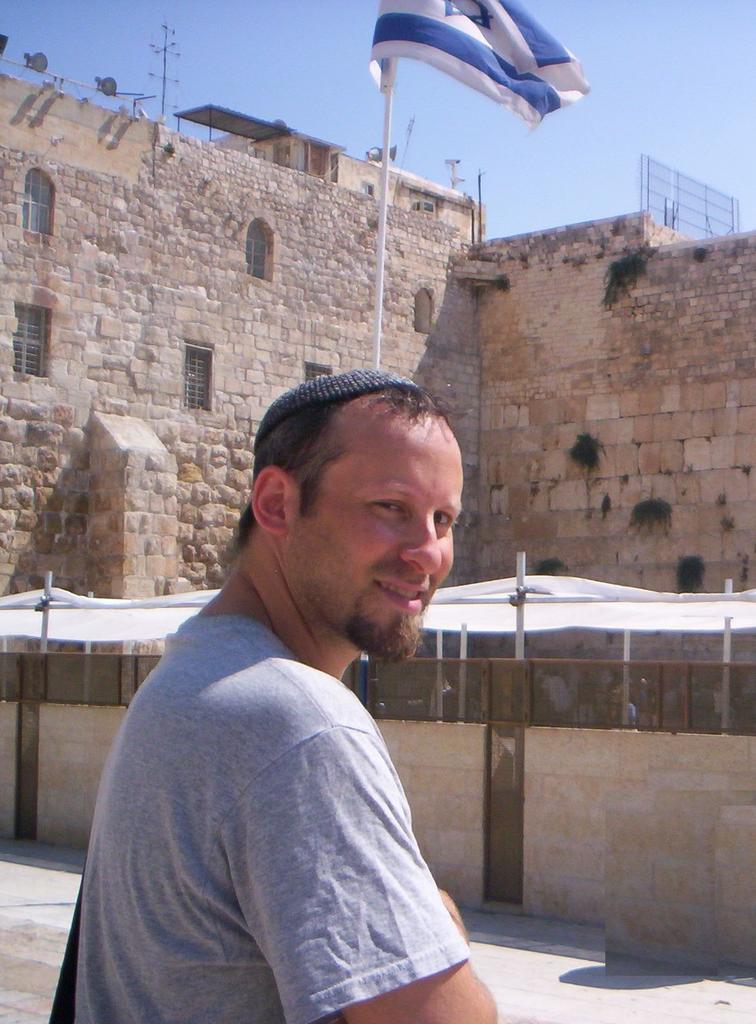
Here I am, wearing my Solomon Schechter T-shirt, standing at the remnant of an outer wall to an ancient place of animal sacrifice. In this photo I am thinking about the contemporary sites of priestly meals: Joy Grill, Olive, Pasha, kukureeku, Doron Falafel, Shnitzi, Take Me Home. O Jerusalem eatires, if I forget ye may my tonugue cleave to the roof of my mouth.
My summer was an intense one – first I spent three weeks working with the young participants of the Face to Face/ Faith to Faith program (I even did the ropes course and zip line some 70 feet above ground.) Then I was off to the Holy Land for a study leave and presentation at the Inter-religious Coordinating Council of Israel. Emek Refaiim Street, where the Inter-religious Coordinating Council’s offices are located is still recovering from the grizzly suicide bombing that left seven dead and fifty wounded at Café Hillel. Yet while every restaurant and café now has a security fence around it and a guard at the entrance, the street is bustling with life. While I was in Jerusalem I had the great pleasure to spend time with one of my inter-religious colleagues in the U.S. – Rev. Paul Rauschenbusch from Princeton University - who is working on promoting inter-religious councils on college campuses. I also met with Palestinian educators, filmmakers, rabbis, and countless others who are working on multifaith projects.
12.7.05
WOR Radio 710

Legendary radio journalist Bill Bertenshaw just interviewed me for Commmunity Concerns - a show on WOR radio 710. It airs September 4th at 5am, so set them alarms and tune in!
11.7.05
Jerusalem or Bust
ICCI cordially invites you to a library seminar
on Wednesday, July 20th, 2005 – 13 Tamuz 5765
12:30 – 14:00
With
Rabbi Daniel Brenner
Director, Center for Multifaith Education, Auburn Theological Seminary
who will speak about
“Imagine No Religion meets Redemption Song: What We've Learned About High School Students and Interreligious Dialogue from the Face to Face/Faith to Faith Program”
at
The ICCI Education Center, 43a Emek Refaim St., Jerusalem
As space is limited, please reserve your place in advance: library@icci.org.il tel: 02-561 1899, fax: 02-563 4148
המועצה הבין-דתית המתאמת בישראל (ICCI)
מתכבדת להזמינכם לסמינר
אשר יתקיים ביום רביעי ה – 20.7.05 (יג' תמוז תשס"ה)
בין השעות 14:00-12:30
ובו נארח את
הרב דניאל ברנר
מהמרכז לחינוך בין-דתי, הסמינריון התיאולוגי אוברן
שישוחח באנגלית על
" תאר לך עולם בלי דתות לעומת שיר הגאולה: מה למדנו על תלמידי התיכון ועל הדיאלוג הבין-דתי
מהתכנית פנים-אל-פנים/ אמונה-מול-אמונה'"
הסמינר יתקיים באנגלית במרכז החינוכי של המועצה הבין דתית, עמק רפאים 43 א' קומה ב'.
מספר המקומות מוגבל! אנא הירשמו מראש: library@icci.org.il טלפון 02-5611899
on Wednesday, July 20th, 2005 – 13 Tamuz 5765
12:30 – 14:00
With
Rabbi Daniel Brenner
Director, Center for Multifaith Education, Auburn Theological Seminary
who will speak about
“Imagine No Religion meets Redemption Song: What We've Learned About High School Students and Interreligious Dialogue from the Face to Face/Faith to Faith Program”
at
The ICCI Education Center, 43a Emek Refaim St., Jerusalem
As space is limited, please reserve your place in advance: library@icci.org.il tel: 02-561 1899, fax: 02-563 4148
המועצה הבין-דתית המתאמת בישראל (ICCI)
מתכבדת להזמינכם לסמינר
אשר יתקיים ביום רביעי ה – 20.7.05 (יג' תמוז תשס"ה)
בין השעות 14:00-12:30
ובו נארח את
הרב דניאל ברנר
מהמרכז לחינוך בין-דתי, הסמינריון התיאולוגי אוברן
שישוחח באנגלית על
" תאר לך עולם בלי דתות לעומת שיר הגאולה: מה למדנו על תלמידי התיכון ועל הדיאלוג הבין-דתי
מהתכנית פנים-אל-פנים/ אמונה-מול-אמונה'"
הסמינר יתקיים באנגלית במרכז החינוכי של המועצה הבין דתית, עמק רפאים 43 א' קומה ב'.
מספר המקומות מוגבל! אנא הירשמו מראש: library@icci.org.il טלפון 02-5611899
3.7.05
The Living Pupik
I just got a fresh batch of The Living Pulpit magazines in the mailbox -- I got a piece on Shavuot in the new issue.
29.6.05
sharing some good news
I just found out from my friend Andrew Silow-Carrol at the NJ Jewish News that I recieved a Simon Rockower Award for Excellence in Jewish Journalism. It was for the commentary I did on the Presby-Israel debate. (Boteach took first place - I took second) I am deeply honored to recieve this recognition.
Thank you Andy for publishing my work!
Thank you Andy for publishing my work!
22.6.05
Here's my latest article -- running in tommorow's Jewish Week
Helping The World’s Poorest Billion People
Daniel S. Brenner
The Talmud teaches that if you see someone drowning in a river, and if you can swim, then you are obligated to jump in and save the person in danger. So considering the fact that a billion people are drowning in a river and you have the opportunity to save them — without even getting wet — why aren’t you throwing a life preserver? This is not a hypothetical question. Last week, sitting with a wonderfully diverse group of religious leaders at the United Nations Church Center, I was faced with its real-life implications. The Church Center has little of the marble glitz of the UN Plaza across the street, but it is the perfect place to ask the most direct questions about the world’s needs: Can we in the world’s wealthiest nations do anything to address the systemic problems of the poorest billion people on the planet. Our work together involved the UN’s Millennium Development Goals. What are they? To be completely honest, I didn’t know about the Millennium Development Goals until I began working at Auburn, a historic Presbyterian seminary on the Upper West Side two years ago. Through my participation in a group called the Consultation for Interfaith Education, the topic crossed my radar screen during a discussion with Sister Joan Kirby, a Catholic activist who works with a nonprofit called the Temple of Understanding. Sister Kirby has helped to transform global missions that once were strictly evangelical operations into social justice ventures that meet the basic food and health needs of people in the developing world. Such Christians feel that faith without works is dead. But can the United Nations actually do anything about extreme poverty? I must confess that like many American Jews, I have held little faith in the United Nations as a political body and find it a startling hypocrisy that human rights violators such as Sudan and Zimbabwe sit on UN human rights commissions. But the Millennium Goals are a different story. Ambassador Eveline Herfkens, the Dutch director of the project and the keynote speaker who addressed us at the Church Center, clarified that the goals are not about making “the impossible possible, but making the possible possible.” And the goals for 2015 are relatively straightforward: Cut in half the number of people living in extreme poverty; insure primary education for all children; promote secondary education for girls; reduce child mortality by two-thirds; improve maternal health; halt the spread of malaria and AIDS; promote environmental sustainability; and create a global development fund. All 189 member states of the United Nations have agreed on the goals, and the European Union states have actually put their share of money behind them. So what does this have to do with the Jewish community? For Christians, Hindus and Muslims, the billion poorest on the planet are co-religionists. Since over 99.99 percent of the poorest are not even remotely part of the Jewish tribe, we might ask ourselves if this is really a Jewish issue. But by the show of Jewish leaders at the Church Center — Conservative, Reform, Reconstructionist and Modern Orthodox — as well as representatives from American Jewish World Service, Mazon and CLAL (whose Michael Gottsegen worked tirelessly to make the conference a success), American Jews apparently do see the needs of the globe’s poorest citizens as being a Jewish concern. Standing side by side with the Evangelical leader Rev. Richard Cizik, Rabbi Irving Greenberg passionately argued, “If the image of God is reflected in humanity, then what does it mean theologically when a woman from Uganda is forced to sell her body for 55 cents to feed her family?” Rabbi Greenberg’s passionate ethical plea was reinforced by the practicality of Professor Don Melnick, a biologist at Columbia University who has been the environmental mastermind behind the UN goals. Melnick’s argument is brilliantly simple — conditions of extreme poverty lead to environmental devastation — especially to the rampant deforestation that is throwing off our planet’s climate and causing ecological disasters worldwide. This poverty also leads to people living in cramped quarters with animals and their filth, which leads to a steady rise in Zoonotic diseases — ones that jump species like SARS and the West Nile virus and AIDS. The dangers of such a virus spreading is increasing as we ignore the plight of the poorest billion. In short, Jewish survival is dependent on planetary survival. And the health of the planet is actually dependent on the health of those billion who are the most in need of our assistance. So the Millennium Goals are a Jewish issue. The bad news, unfortunately, is that the United States, which can take the lead in meeting these goals, is dragging its feet. While our president has been given credit for extending $674 million in emergency aid (mostly to Ethiopia and Eritrea), the reality is that we rank a dismal 21st of the 22 wealthiest nations in generosity. To insure that we reach the goals by 2015, the United States must raise our aid from .016 to .07 percent of our gross national income — a small price to pay for the survival and health of the planet. The G8 summit, which will gather the world leaders in Scotland on July 6, is the window of opportunity for success for the goals program. If it is a mitzvah to save the life of one drowning man, woman or child, I would hope that the Jewish community can join the multifaith efforts now under way across the United States to promote the goals, to encourage our elected representatives to fund them, and to throw a life preserver to the billion and beyond.
Rabbi Daniel S. Brenner directs the Center for Multifaith Education at Auburn Theological Seminary in Manhattan.
Special To The Jewish Week
Daniel S. Brenner
The Talmud teaches that if you see someone drowning in a river, and if you can swim, then you are obligated to jump in and save the person in danger. So considering the fact that a billion people are drowning in a river and you have the opportunity to save them — without even getting wet — why aren’t you throwing a life preserver? This is not a hypothetical question. Last week, sitting with a wonderfully diverse group of religious leaders at the United Nations Church Center, I was faced with its real-life implications. The Church Center has little of the marble glitz of the UN Plaza across the street, but it is the perfect place to ask the most direct questions about the world’s needs: Can we in the world’s wealthiest nations do anything to address the systemic problems of the poorest billion people on the planet. Our work together involved the UN’s Millennium Development Goals. What are they? To be completely honest, I didn’t know about the Millennium Development Goals until I began working at Auburn, a historic Presbyterian seminary on the Upper West Side two years ago. Through my participation in a group called the Consultation for Interfaith Education, the topic crossed my radar screen during a discussion with Sister Joan Kirby, a Catholic activist who works with a nonprofit called the Temple of Understanding. Sister Kirby has helped to transform global missions that once were strictly evangelical operations into social justice ventures that meet the basic food and health needs of people in the developing world. Such Christians feel that faith without works is dead. But can the United Nations actually do anything about extreme poverty? I must confess that like many American Jews, I have held little faith in the United Nations as a political body and find it a startling hypocrisy that human rights violators such as Sudan and Zimbabwe sit on UN human rights commissions. But the Millennium Goals are a different story. Ambassador Eveline Herfkens, the Dutch director of the project and the keynote speaker who addressed us at the Church Center, clarified that the goals are not about making “the impossible possible, but making the possible possible.” And the goals for 2015 are relatively straightforward: Cut in half the number of people living in extreme poverty; insure primary education for all children; promote secondary education for girls; reduce child mortality by two-thirds; improve maternal health; halt the spread of malaria and AIDS; promote environmental sustainability; and create a global development fund. All 189 member states of the United Nations have agreed on the goals, and the European Union states have actually put their share of money behind them. So what does this have to do with the Jewish community? For Christians, Hindus and Muslims, the billion poorest on the planet are co-religionists. Since over 99.99 percent of the poorest are not even remotely part of the Jewish tribe, we might ask ourselves if this is really a Jewish issue. But by the show of Jewish leaders at the Church Center — Conservative, Reform, Reconstructionist and Modern Orthodox — as well as representatives from American Jewish World Service, Mazon and CLAL (whose Michael Gottsegen worked tirelessly to make the conference a success), American Jews apparently do see the needs of the globe’s poorest citizens as being a Jewish concern. Standing side by side with the Evangelical leader Rev. Richard Cizik, Rabbi Irving Greenberg passionately argued, “If the image of God is reflected in humanity, then what does it mean theologically when a woman from Uganda is forced to sell her body for 55 cents to feed her family?” Rabbi Greenberg’s passionate ethical plea was reinforced by the practicality of Professor Don Melnick, a biologist at Columbia University who has been the environmental mastermind behind the UN goals. Melnick’s argument is brilliantly simple — conditions of extreme poverty lead to environmental devastation — especially to the rampant deforestation that is throwing off our planet’s climate and causing ecological disasters worldwide. This poverty also leads to people living in cramped quarters with animals and their filth, which leads to a steady rise in Zoonotic diseases — ones that jump species like SARS and the West Nile virus and AIDS. The dangers of such a virus spreading is increasing as we ignore the plight of the poorest billion. In short, Jewish survival is dependent on planetary survival. And the health of the planet is actually dependent on the health of those billion who are the most in need of our assistance. So the Millennium Goals are a Jewish issue. The bad news, unfortunately, is that the United States, which can take the lead in meeting these goals, is dragging its feet. While our president has been given credit for extending $674 million in emergency aid (mostly to Ethiopia and Eritrea), the reality is that we rank a dismal 21st of the 22 wealthiest nations in generosity. To insure that we reach the goals by 2015, the United States must raise our aid from .016 to .07 percent of our gross national income — a small price to pay for the survival and health of the planet. The G8 summit, which will gather the world leaders in Scotland on July 6, is the window of opportunity for success for the goals program. If it is a mitzvah to save the life of one drowning man, woman or child, I would hope that the Jewish community can join the multifaith efforts now under way across the United States to promote the goals, to encourage our elected representatives to fund them, and to throw a life preserver to the billion and beyond.
Rabbi Daniel S. Brenner directs the Center for Multifaith Education at Auburn Theological Seminary in Manhattan.
Special To The Jewish Week
1.6.05
Festival Cordoba!

There's me --- with Imam Faisal Abdul Rauf, Daisy Khan, and Reb Michael Paley - on stage at the Knitting Factory!
Festival Cordoba:
A Celebration of
Muslim and Jewish Music
@ the KNITTING FACTORY
THURSDAY JUNE 16th 7:30 PM
WITH AMIR VAHAB and PHAROAH's DAUGHTER
Amir Vahab is one of New York’s most celebrated and distinguished composer / vocalists of Persian sacred and folk music. Born in Teheran, he sings in the traditional Persian style, which embodies millennia of the theoretical and mystical traditions of the ancient land of Iran. He has spent more than three decades perfecting his skills under the instruction of some of the most renowned and legendary masters of Persian music. His albums include Rumi: Celebration, Rumi: Meditation, Devotional Songs, Nostalgic Journey, and Amir Vahab Live in Concert. In 2003 he was dubbed by the New York Times as the “master of all musical things Iranian.”
Pharoah’s Daughter Basya Schechter formed the band, Pharaoh's Daughter, in 1995, following her travels in Morocco, the Middle East, South America and Africa. Inspired by these cultures and the Hasidic melodies of her childhood, she began playing her guitar so it would sound like a blend of an Arabic oud and a Turkish saz, with harmonic minor melodies and odd rhythms. Last summer, Pharaoh's Daughter debuted their mix of Middle Eastern, Hasidic and klezmer sounds at Central Park’s Summer Stage. The group has toured internationally, recorded four albums Queen’s Dominion, Exile, Out of the Reeds, Daddy’s Pockets, and is currently working on a fifth, Hagar.
CO-SPONSORS:
ASMA: AMERICAN SOCIETY FOR MUSLIM ADVANCEMENT
AUBURN THEOLOGICAL SEMINARY – CENTER FOR MULTIFAITH EDUCATION
BRONFMAN YOUTH FELLOWSHIP IN ISRAEL
JEWISH COMMUNITY RELATIONS COUNCIL OF NEW YORK
UJA- FEDERATION OF NEW YORK
ISLAMIC CULTURAL CENTER OF NEW YORK
19.5.05
Spring Poetry Special
Poetry is not my life
Ferllenghtti sits perched atop the bathroom radiator
And I savor a page every time my body recycles
Thanking God for the openings and the hollow places
And the subtlety of uncapitalized letters
Though a dozen boxes of notebooks with scribbled fragments of verse
will crush you if you attempt to open my closet door
Poetry is not my life
Though there was a time
When I left my cozy air conditioned world
rode a beat up bicycle to the dangerous part of town
Picked through dumpsters to find relics that spoke truth
Searched for poems in the broken glass under the train tracks
Talked to old folks, bodies reeking of ten varieties of decay,
Untreated wounds festering, discolored,
Rotting teeth clicking a different rhythm for each tale,
The young people called me ain’t from the ghetto
And that, too, I made into a poem
Poetry is not my life
What is?
Let me begin by saying that I’ve changed a thousand diapers
A real man changes a thousand diapers
But my beloved changed two thousand
So I best not open my mouth
Poetry is not my life
I pay bills for natural gas
I insulate the attic – it’s itchy
I work in front of a computer screen
I wash out the thermoses from the kid’s lunchboxes
Poetry is not my life
Thank God I have money
I like those English water crackers with a slice of fancy feta cheese
And my children have health care coverage
And I can do my laundry in machines in my basement
When you have too little or too much
Money plays with your mind
Since I have some money
Poetry is not my life
My life is taking the shortcut through the tire store parking lot to catch the train
My life is trying to change the world by making minor adjustments
My life is trying to get my kids to finish their Cheerios
Oil changes
Dental appointments
E-mails
And though I wish I could end with graceful poetic irony
Poetry is not my life
- Daniel S. Brenner
Ferllenghtti sits perched atop the bathroom radiator
And I savor a page every time my body recycles
Thanking God for the openings and the hollow places
And the subtlety of uncapitalized letters
Though a dozen boxes of notebooks with scribbled fragments of verse
will crush you if you attempt to open my closet door
Poetry is not my life
Though there was a time
When I left my cozy air conditioned world
rode a beat up bicycle to the dangerous part of town
Picked through dumpsters to find relics that spoke truth
Searched for poems in the broken glass under the train tracks
Talked to old folks, bodies reeking of ten varieties of decay,
Untreated wounds festering, discolored,
Rotting teeth clicking a different rhythm for each tale,
The young people called me ain’t from the ghetto
And that, too, I made into a poem
Poetry is not my life
What is?
Let me begin by saying that I’ve changed a thousand diapers
A real man changes a thousand diapers
But my beloved changed two thousand
So I best not open my mouth
Poetry is not my life
I pay bills for natural gas
I insulate the attic – it’s itchy
I work in front of a computer screen
I wash out the thermoses from the kid’s lunchboxes
Poetry is not my life
Thank God I have money
I like those English water crackers with a slice of fancy feta cheese
And my children have health care coverage
And I can do my laundry in machines in my basement
When you have too little or too much
Money plays with your mind
Since I have some money
Poetry is not my life
My life is taking the shortcut through the tire store parking lot to catch the train
My life is trying to change the world by making minor adjustments
My life is trying to get my kids to finish their Cheerios
Oil changes
Dental appointments
E-mails
And though I wish I could end with graceful poetic irony
Poetry is not my life
- Daniel S. Brenner
12.5.05
On Alzheimer's
Rev. Jim Forbes from Riverside Church tells a story about his Father:
When 'Bishop' sat in the nursing home, his mind rattled by demensia, he was called by the nurses "Praise the Lord" -- Why? Because whatever happened he said "Praise the Lord" lunch - PTL, blood drawing time - PTL, light on - PTL, light out -PTL. As the 'dust was shaken off' -- as his memory slipped away and he turned to the 'winter' in his life (with the leaves falling off the tree) his trunk and roots were still soaking in the light of God's presence.
Then Forbes read Psalm 139, emphasisizing the angry screed that comes in the penultimate lines. "That anger," he said, "was for the moment when "praise the Lord" left his mind and he lay confused before dying.
This was one highlight of the Alheimer's Conference today at Auburn.
When 'Bishop' sat in the nursing home, his mind rattled by demensia, he was called by the nurses "Praise the Lord" -- Why? Because whatever happened he said "Praise the Lord" lunch - PTL, blood drawing time - PTL, light on - PTL, light out -PTL. As the 'dust was shaken off' -- as his memory slipped away and he turned to the 'winter' in his life (with the leaves falling off the tree) his trunk and roots were still soaking in the light of God's presence.
Then Forbes read Psalm 139, emphasisizing the angry screed that comes in the penultimate lines. "That anger," he said, "was for the moment when "praise the Lord" left his mind and he lay confused before dying.
This was one highlight of the Alheimer's Conference today at Auburn.
2.5.05
A Muslim - Christian Delegation Vists the Rabbi
Last week I hosted the following three folks for a lively lunchtime meeting:
Dr. Antoine Messara (Lebanese Christian) is a professor at the Lebanese University Department of Communication, and is the general director of The Foundation of the Lebanese Association for Permanent Civil Peace in Lebanon. Antoine established The Foundation of the Lebanese Association for Permanent Civil Peace in Lebanon during the civil war in Lebanon by bringing Christians and Muslims together. He is active in issues related to democracy, human rights, and Christian Muslim relations. Antoine has many articles addressing the issue of democracy and co-existence.
Samir Morcos (Egyptian Christian) is the former associate general secretary of Middle East Council of Churches. He has consulted for the Coptic Center for Social Studies, Al Fustat Center for Studies and Consultations, and for The Unit for Citizenship and Dialogue in Cairo. Samir has written multiple books in the area of development including: The State of Civil Society in Egypt: Preliminary Observations and Future Possibilities; and, Civil Society in Egypt: From Dormancy to Action-The Struggle over the Civil Associations Law. He is currently writing a joint study entitled Civil Society in Egypt: Challenges and Future Prospects, as well as a critical review of development concepts and practices in Egypt over the past 50 years. Samir was awarded the annual prize in 2004 of the Norwegian Academy for Literature and Freedom of Expression.
Nadia Mahmoud Mustafa (Egyptian Muslim) is a professor in the political science department and on the faculty of economics and political science at Cairo University. She has taught the following subjects: The Evolution of International Political Relations; Political Development; Arab Foreign Policies; Contemporary Global Issues; Islamic Political Thought; Arab World in International Politics; and Theory of International Relations. She has also written multiple books, including: Strategy of Islamic Cultural Activity in the West, and Developing an Islamic Perspective to the Study of International Relations: Dilemmas of the Experience of Teaching and Research.
Highlights included Samir speaking of the Darfur crisis as a battle between China and the U.S. for resources. I ended up spending twenty minutes or so after the public program engaging in a debate with Nadia, who dismissed all "grassroots" efforts between Israelis and Palestinians. "Peace must come from the governments above! How can the occupied speak with the occupier!"
Dr. Antoine Messara (Lebanese Christian) is a professor at the Lebanese University Department of Communication, and is the general director of The Foundation of the Lebanese Association for Permanent Civil Peace in Lebanon. Antoine established The Foundation of the Lebanese Association for Permanent Civil Peace in Lebanon during the civil war in Lebanon by bringing Christians and Muslims together. He is active in issues related to democracy, human rights, and Christian Muslim relations. Antoine has many articles addressing the issue of democracy and co-existence.
Samir Morcos (Egyptian Christian) is the former associate general secretary of Middle East Council of Churches. He has consulted for the Coptic Center for Social Studies, Al Fustat Center for Studies and Consultations, and for The Unit for Citizenship and Dialogue in Cairo. Samir has written multiple books in the area of development including: The State of Civil Society in Egypt: Preliminary Observations and Future Possibilities; and, Civil Society in Egypt: From Dormancy to Action-The Struggle over the Civil Associations Law. He is currently writing a joint study entitled Civil Society in Egypt: Challenges and Future Prospects, as well as a critical review of development concepts and practices in Egypt over the past 50 years. Samir was awarded the annual prize in 2004 of the Norwegian Academy for Literature and Freedom of Expression.
Nadia Mahmoud Mustafa (Egyptian Muslim) is a professor in the political science department and on the faculty of economics and political science at Cairo University. She has taught the following subjects: The Evolution of International Political Relations; Political Development; Arab Foreign Policies; Contemporary Global Issues; Islamic Political Thought; Arab World in International Politics; and Theory of International Relations. She has also written multiple books, including: Strategy of Islamic Cultural Activity in the West, and Developing an Islamic Perspective to the Study of International Relations: Dilemmas of the Experience of Teaching and Research.
Highlights included Samir speaking of the Darfur crisis as a battle between China and the U.S. for resources. I ended up spending twenty minutes or so after the public program engaging in a debate with Nadia, who dismissed all "grassroots" efforts between Israelis and Palestinians. "Peace must come from the governments above! How can the occupied speak with the occupier!"
13.4.05
a pre-pesach poem
I read the hagaddah backwards this year
The sea opens, the ancient Israelites slide back to Egypt like Michael Jackson doing the moonwalk
Freedom to slavery
That’s the real story
One minute you’re dancing halleluyah with the prophetess
The next you’re knee deep in brown in the basement of some minor pyramid waiting for the angel of death to refund your two zuzim.
Children of Israel! It is hard to say dayenu when the armies emerge from the sea like a returning scuba expedition and the Pharoah calls out for fresh towels.
The bread has plenty of time to rise.
I read the haggadah backwards this year,
Left a future Jerusalem,
scrubbed off the blood from the doorposts
wandered back to Aram.
The sea opens, the ancient Israelites slide back to Egypt like Michael Jackson doing the moonwalk
Freedom to slavery
That’s the real story
One minute you’re dancing halleluyah with the prophetess
The next you’re knee deep in brown in the basement of some minor pyramid waiting for the angel of death to refund your two zuzim.
Children of Israel! It is hard to say dayenu when the armies emerge from the sea like a returning scuba expedition and the Pharoah calls out for fresh towels.
The bread has plenty of time to rise.
I read the haggadah backwards this year,
Left a future Jerusalem,
scrubbed off the blood from the doorposts
wandered back to Aram.
Trenton Makes, The World Takes
After a performance Saturday night at Trenton's Passage Theater by the brilliant beat-boxer Yuri Lane Lisa and I had the great pleasure to be a guest at a party of the Goldstein-Ballingers and share a bottle of wine with NJ's original poet laureate Gerald Stern. He was captivating - well into his eighties he is as hip and irreverent as the twenty-somethings who hang out at P.S. 122. Yusuf Komunyaka, the Pulitzer prize winning poet, was there too as was Chris Hedges, the political journalist - and for a moment I thought that the historic Mill Hill district of Trenton would be the site of the next American revolution. Maybe the whale who swam up the Delaware could sense it too.
23.3.05
Iceland cometh and goeth
Meeting with the group from Rekjavik was fascinating. Half of them said that I was the first Jew they had ever spoken to. After my presentation one student wanted to know "How America, which is such a religiously diverse nation, could elect such an 'extreme Christian' to the White House?" That led to a wider discussion about religious tolerance (and intolerance) in America. They were not aware of the campaign by Bush post 9-11 to get across the message that Islam is a 'religion of peace' - they had only heard of Lt. Gen Boykin's demonization of Muslims. Tommorow night they are going to Bnai Jeshurun for Purim. I wish I could go to see their reaction.
17.3.05
Amina Wadud
A nice Jewish boy arranging security for a radical Muslim? Only in New York.
I spent a good part of the day addressing the security concerns for the speaker at Auburn this evening, the Muslim woman activist Amina Wadud. See www.muslimwakeup.com for more on the event. The woman is breaking the barriers like my Women of the Wall sisters did in Jerusalem. Tommorow she will lead the first egalitarian muslim prayer service. Al -Jazeera is all over this.
I spent a good part of the day addressing the security concerns for the speaker at Auburn this evening, the Muslim woman activist Amina Wadud. See www.muslimwakeup.com for more on the event. The woman is breaking the barriers like my Women of the Wall sisters did in Jerusalem. Tommorow she will lead the first egalitarian muslim prayer service. Al -Jazeera is all over this.
Subscribe to:
Posts (Atom)