Click here to visit the new and improved blog at www.rabbidanielbrenner.com!
10.6.13
Florence Funt (1912-2013) Z'L
I've heard conflicting ideas regarding the spirit world that we refer to as heaven. But if I was to make a prediction about what is currently underway in that upward eternal everlasting time zone out there, I'd have to say that those spirits are about to experience a period of unexpected fun. Scrabble games and Hungry, Hungry Hippos, croquet contests, wacky wind-up toys, a wooden puppet who dances on a plank - did I mention boxes full of chocolate, and dogs who go gaga for ice cream, and plastic alligator heads on sticks that pick up scrap paper or a mechanical frog who eats bean bag flies? And what about the vast library of New Yorker cartoons, comics and joke books? Yes, other-world, you now get to experience the woman known as Granny - the force that made earth such a delightful realm for so many children and adults alike. So, Heavens - consider yourself lucky!
love you Granny. miss you. hope to grow your spirit more and more.
30.5.13
Jews in Guatemala
My beloved and I just returned from an amazing five-day trek in Guatemala. Visiting our friends in Antigua, traveling to Lake Atitlan to visit Santiago - it was an amazing journey.
Here are the top 100 of the 1,000 photos I took.
As part of the trip, we spent time with a Mayan woman (actually a Tz'utujil Mayan) named Dolores Ratzun. You can read about her life here. If you go to Atitlan, hire her for a tour - she is a superb guide.
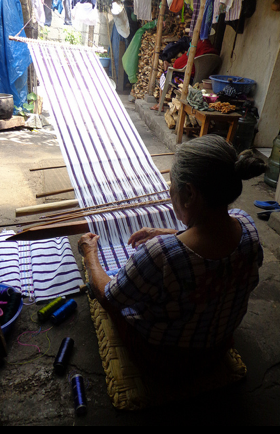
She took us to two Mayan shrines and to Mass at the Catholic Church in Atitlan (built with the steps of the old Mayan shrine) and then to her parents' home. As her mother showed us her two looms for weaving ritual cloth, Dolores asked me about cloth in Jewish life.
I told her about the Tallit, tzitzit, and techelet and she shared the symbolism of the cloth that her mother had woven. Dolores - who is a healer and shaman -wanted to learn more about the tallit so I am sending her some youtube clips.
Meeting her reminded me of one of the most powerful experiences that I had as a child in Jewish Day School. We made our own tallesim, choosing the cloth and then learning to tie the tzitzit. My tallis, made of a light denim fabric with a rainbow trim, is now one of the objects I consider most sacred in my life.
It took traveling to Guatemala for me to realize how important it is to retain the connection to sacred fabric and to the quiet power of interwoven strings. I'll think of her mother's loom as I make the "al tzitzit" blessing.
13.5.13
The Terrorist's Terrible Toothache
I will be reading my latest short story, The Terrorist's Terrible Toothache, on Saturday, May 18th at B'nai Keshet 99 South Fullerton, Montclair NJ @ 8PM. The reading will be part of a literary salon that will include playwrights, songwriters, a dancer, poets, and apparently my beloved. Anyways - If you are interested in The Terrorist's Terrible Toothache then come on down to Montclair!
12.5.13
Top Five Shavuot Songs
I've made a list of the top five songs for shavuot over on a new blog entitled Shavuot Songs. What made the list this year? Check it out.
14.4.13
8.4.13
Alternative Ketubah
File this one as an "only in New York" moment...
About a month ago I was in Williamsburg (the Brooklyn one) officiating a wedding for a wonderful couple who had the highly unusual ketubah pictured above. On their honeymoon in Argentina, they visited the artist. Then the artist wrote up a little story about it:
I skimmed through the other Ketubahs on the site and all I can say is that I want to hang out with the couple who uses that Dr. Seuss themed ketubah.
I'm going to add this Ketubah outfit to my list of best of:
Best Wedding DJ?
Adam Oded
Best Wedding Photographer?
Melanie Einzig
2.4.13
18.3.13
How to Chop Walnuts
Haroset? Charoset? Charoses? Haroses? Whatever you call it, I love it so much that I wrote a song about it. Anyways, enough blogging, click play and enjoy "Chopped Up Walnuts"
13.3.13
Did God Kill Egyptians?
My latest piece about the Passover story is up on the Huffington Post (click here to check it out!) and it is yet another example of how many people read that site. 106 comments within the first 24 hours...and I imagine that there are more to come. I love reading the comments for both the crazies and for my own learning. Anyways - enjoy!
12.3.13
I penned this piece ten years ago, back when I was on the faculty of CLAL. Reading it again, I am struck by the line:
"We are living in a time of war, shifting alliances, new dangers, increasing uncertainty and growing poverty."
Even more true today than a decade ago, methinks. Anyways - Andre Neher's words are still a powerful call:
Passover - The Unfinished Manuscript
By Daniel S. Brenner
In the last sixty years, the words of the Passover Haggadah have marked the flow of history. At a makeshift seder in the Bergen-Belsen concentration camp in 1944 the leader recited, "This is the bread of our affliction!" At a seder on the beaches of Tel Aviv in 1948, new immigrants sang, "Blessed be the Guardian who kept his promise to Israel!" At a seder in a Black church in Washington, D.C. in 1969, young civil rights activists called out, "In every generation, every Jew must regard himself as though he, personally, had been brought out of Egypt." At the seder of Ethiopian Jews in a resettlement camp in 1992 families recited, "God brought us out from there, so that we are led to the land promised our ancestors!" And at seders last year, in the hours after the suicide bomber struck down 29 in Netanya, we said, "In every generation they have stood against us to destroy us, but the Holy One, blessed be, has delivered us from their hand."
Each year brings a new context to the seder, and the events on the front pages and on the front-lines cause ancient words to find new meanings. Yet the overall story does not change. No turn of events causes us to waver from our ultimate dream -- that all who are oppressed know freedom, that all who serve under Pharaohs know true justice, and that all who are exiled or abandoned can find a place to call home.
Andre Neher, the prolific Jewish scholar who was born in Alsace at the beginning of World War I, lived through cataclysmic changes. After surviving the destruction of much of European Jewry and then helping to rebuild it, he wrote the following words on the experience of Passover:
No Jew can pass the Haggadah untouched, for its style is not narrative, but interrogative. Its story is not told like a legend, but like a problem. One initial question is asked, and all the others follow from it: "What is the difference between this night and all other nights?" It is for the Jew to answer if he can, and if cannot, to feel that the question contains a challenge. Like an unfinished play, the night of the Exodus continues through the centuries, seeking actors to relive it perpetually, and to grasp its essential meaning.
(Moses and the Vocation of The Jewish People, 1959)
To take Neher's insight further, the Haggadah not only acts as a partially written script, but as a script whose lines take on new meaning every year. In that light, each year we must ask: What words will ring true this Passover? What new connections will resonate?
This year, it is uncertain what line will leap from the text of the Haggadah and grasp our attention. We are living in a time of war, shifting alliances, new dangers, increasing uncertainty and growing poverty. But we retain the hope that we will one day be able to truly say: Let all who are hungry come and eat; let all who are in need celebrate Passover with us.
On this night of questions, as you join your friends or family around the seder table, you might begin by asking each person to recall one news event from the past few months. As a group, pick one of these events and ask: How is the Exodus story being played out in the headlines? How can telling the story of the Exodus deepen our understanding of these events? How are we reminded that we "were once strangers in a strange land?”
As you read through the Haggadah, keep in mind Andre Neher's teaching that "the Exodus continues through the centuries, seeking actors to relive it perpetually, and to grasp its essential meaning." The more connections we draw, the closer we get to the essential meaning of Passover. May you be blessed with a festival of hope.
11.3.13
Free Passover Play
If you're looking for an easy way to add some good drama to your Passover Seder, then you are in the right place. I've got twenty people coming to the first seder and probably as many to the second. Rather than read through the Haggadah's maggid section, we'll have fun with this short skit that tells the story. I offer it free to all those who would like to spice up their seders. Enjoy - and Zissen Pesach!
Daniel
Free Passover Play
What are rabbis for?
Here is an excerpt from a recent speech that I gave "installing" a rabbi:
When I was young, my favorite book that my parents read to
me was Leo Leonni’s Frederick.
Lionni was born in Amsterdam, the son of an Italian Jew, and
he came to Philadelphia in 1939. He wrote Frederick in 1967. Here is the story:
there is a group of field mice and they are all gathering grains and other
foodstuffs for the coming winter months. All except for one – Frederick. What
is Frederick doing? He is sitting watching the sunset, he is chasing
butterflies, he’s watching the wheat blow in the wind. What are you doing? The
other field mice say. “I am gathering colors” he says. Some of the mice mock
him. But then, as they huddle together in darkness, for months on end, the
field mice get depressed. Frederick begins to tell stories of the colors. He paints
a picture for them in such a way that their winter depression is lifted and
they all come to see the importance of his sacred task.
What, as we enter 2013, is the role of a communal spiritual
leader? What is a rabbi for?
I want to suggest that there are two forces that are shaping
our world as we enter into 2013.
The first is what I’ll call the global digital revolution.
Future generations will look back on Steve Jobs as we look back on Thomas
Edison, and Galielo Galeli. The instant interconnection of the globe through
shared information is, indeed, a monumental shift in human culture. Within seconds,
we can see what is going on all over the globe. A few weeks ago, I
simultaneously watched a live feed from Gaza City and from Sderot from the
comfort of my home in Montclair. At the same time, I was Gchatting with my Israeli
cousins, reading Facebook rants from my friends on the left and the right, and shopping
for Hannukah gifts.
In some ways, the inter-connectivity is amazing. We can now access
libraries and news and order flaxseed, shoe polish, hair gel, and garden
gnomes.
But the inter-connectivity also has a downside, evidenced in
the network of thieves, human traffickers, and nefarious predators who are harnessing
the digital world for destructive purposes. The world has become a more
dangerous place.
But what I want to focus attention not on the benefits or
drawbacks of the digital era, but the way in which the digital era has produced
a spiritual crisis. In our day, we want everything immediately, we can’t focus
on one task, we are frustrated by anything that is not lightning fast, and we
have an information overload.
Many students in our schools have little idea where to begin
in navigating a flood of information and in dealing with the peer pressure that
exists in digital environments. Thinking critically is not valued in our
educational testing system and our children need strong mentors and teachers
and parents who can help them to be discerning.
We know more than we have ever known about the human body,
about the bio-chemical make-up of our brains, about our digestive system,
respiratory system, and immune system. And yet, when we or someone we love is faced
with illness, we are lost in a sea of information. A flood of possibilities
surround us and information contradicts other information and there are no
simple answers to the ongoing mysteries of the human body.
The spiritual crisis of the digital era leads us to want
fast answers to questions that may not be answerable.
The second force that is surging today is also global. It is
a global resurgence of religious tribalism – a worldview that offers fast
answers. Religious leaders, who often
use the tools of the digital era, paint modernity and science as a weapon of
the good. They call for a return to patriarchy and an end to all judicial systems
that exist outside of the religious authorities. We see this resurgence
particularly in nations whose people have seen years of government corruption
and have lose their faith in pluralist, secular systems of governance.
This rise in religious extremism presents a spiritual crisis
for us as well. All those who do not pledge allegiance to the leaders of these
sects are labeled as illegitimate. In Muslim, Chrisitan, and Jewish circles the
level of hatred between these resurgent traditionalists and all other adherents
has grown. Many young Jewish people grow up today thinking that unless you are
in the most anti-modern yeshivah, then you are not really practicing Judaism.
These two forces are very real and our world needs leaders who can help us to navigate them.
What is needed to navigate a global digital world?
A rabbi who understand how the digital revolution is
changing the way that people are learning and socializing, but who champions
the wisdom of our ancient technologies – reading, conversation, ritual, poetry
and silence.
What is needed in a world of narrow religious tribalism?
A rabbi who has great love and respect for tradition, but
who is willing to balance that respect with a respect for modernity and the new
ways in which we are coming to understand what it means to be human and to be
in community. A rabbi who is not afraid to think critically about tradition and
not afraid to be a public spokesperson who defends the Jewish people.
7.2.13
Free Purim Shpiel Script
which contains a free Purim Shpiel script based on the story of the Book of Esther. It is titled The Whole Megillah. Feel free to cut and paste from it as you like!
22.1.13
Kadosh Baruch Hu
Rabbi Kerry Olitzky was kind enough to ask me to contribute a poem to his new collection titled "Jewish Men Pray." The catch was that I had to direct my poem to the Holy One - or as we say in Hebrew "kadosh baruch hu."
For the interwebs I decided to go with a spoken word/image montage. I hope that you enjoy my attempt and will consider the book for your collection.
21.12.12
A Very Kosher Christmas Poem
Jews
on Christmas
There
isn’t enough soy sauce in the world to feed
Jews
on Christmas
Huddled
around steaming plates of dumplings
Discussing
cinematography
Angioplasty
Lactaid
Who
has lived and who has died
Shocked
to hear that the hot new Hollywood star is actually half-Jewish
(and
not arguing which half)
I
don’t see what all the fuss is about Nathan Englander.
Yes,
it’s like The Wire, but different,
Costco
is a mixed blessing,
Do
you trust Yelp?
On
our smartphones we subtract the Chinese year from the Jewish year to see how
long the Jews had to wait to try egg drop soup.
The
laughter of Jews on Christmas
shakes
the jade Buddha under the faux waterfall from his
sleepy serenity
sleepy serenity
And
for a moment, the enlightened one opens his eyes,
smiling
contently as he joins us to look at pictures of relatives at Harry Potter world.
Now
he's Jewish too.
The
Moo Shu comes with little tortillas, pancakes, wraps,
whatever you want to call them.
And
we wrap up the mush of last year, with all of it’s regrets and tzuris,
And
immerse into soy sauce,
a
ritual bath,
three
times dipped,
and
we say – this is not bad.
Our
highest compliment.
- Daniel S. Brenner
30.11.12
A Minor Holiday: Hannukah Take Two!
29.11.12
Hannukah: A Minor Holiday
I wrote this song way back in 2009....which seems ages ago. I think there were still Macabees alive back then. I recorded it once at a house party (thank you Rafi and Jared and Noam for joining me on that version) but returning to the lyrics I felt that a jazzier setting would be more suitable. So...here goes my Hannukah song. Enjoy, and please share with your friends - who knows, maybe a lo-fi tune that doesn't copy the latest catchy dance song can actually spread a little holiday cheer this year?
16.11.12
Thoughts on Gaza
Thinking aloud: I am blessed with friends on the Right and on the Left. Nearly everything I see posted on Facebook tonight about the current IDF vs. Hamas situation is either saying a) "look at all the suffering that these murderers are causing" or b) "let's just have peace/love each other" (and though I have an open and feeling heart and have learned to breath in and out slowly I am still
not sure what that really means when people are in fear of their lives because all around them they hear explosions) or c) "this is all part of some geo-political military master plan." Here is my "d" -
This is a unique situation with complex histories on both sides and both societies are lead by political leaders who have their own ideas about how to handle the situation (often separate from the people that they represent) and those ideas are a combination of their love for their people, their read of the external and internal forces impacting national security, and their own desire to stay in power. This is a war between two men and two very different types of armies and they both have major outside supporters who may or may not get involved. And those major outside supporters have the capability to destroy the entire region.
On a personal level, I care deeply about my friends and family in Israel and I salute those who have the difficult job of protecting the State. I hope that their surveillance will lead them to weapons caches and that taking out hundreds of buildings and vehicles will be a major setback for the Hamas rocket program. I cried while reading a report from an Israeli radiologist who looked at scans of shrapnel in children's bodies and I mourn for the three innocent Israelis whose lives have been violently taken away by the hands of those bent on revenge or rage and I wish for healing for all those who have been injured. And, at the same time, with the same heart and head, I grieve for those Gazans and residents of Gaza who have been caught in the crossfire. While I am not an endless font of compassion and I do not grieve for those who shoot rockets at civilian targets, the photos I saw and the tweets I read this evening from Gaza have reminded me of the unintended results of an urban operation with hundreds of targets.
Surfing the web conversation, I also stumble into a world of anger. At times I want to scream out:
Those who accuse Israel of genocide - your hyperbolic attitude is one of the factors that is escalating the conflict!
Those who deny the suffering of Gazans - your hard-heartedness and snide attitude are soul-crushing!
But I have little energy for screaming at people whose voices are already speaking through bullhorns.
So I return to the simple belief that we can all play a helpful role in this conflict by being honest about the complexities of the situation, having an open heart towards the panic and suffering on both sides of the border (and around the world for that matter), and by advocating for a long-term vision for the region which envisions safe borders, mutual recognition, and government cooperation. Such a vision is, on a day like today, hard to imagine. But sometimes sworn enemies learn to get along.
As a Jew, I want people to know that my people are going through a really difficult time and that we are all reading news from friends and family in Israel and that the fear of escalation from other powers in the region is very real.
As a human, I want people to know that I am willing to hear all perspectives, and to work for a world where there are fewer injustices and where different peoples can co-exist and live freely.
Tonight my prayer is for a boring and pragmatic end to the conflict.
This is a unique situation with complex histories on both sides and both societies are lead by political leaders who have their own ideas about how to handle the situation (often separate from the people that they represent) and those ideas are a combination of their love for their people, their read of the external and internal forces impacting national security, and their own desire to stay in power. This is a war between two men and two very different types of armies and they both have major outside supporters who may or may not get involved. And those major outside supporters have the capability to destroy the entire region.
On a personal level, I care deeply about my friends and family in Israel and I salute those who have the difficult job of protecting the State. I hope that their surveillance will lead them to weapons caches and that taking out hundreds of buildings and vehicles will be a major setback for the Hamas rocket program. I cried while reading a report from an Israeli radiologist who looked at scans of shrapnel in children's bodies and I mourn for the three innocent Israelis whose lives have been violently taken away by the hands of those bent on revenge or rage and I wish for healing for all those who have been injured. And, at the same time, with the same heart and head, I grieve for those Gazans and residents of Gaza who have been caught in the crossfire. While I am not an endless font of compassion and I do not grieve for those who shoot rockets at civilian targets, the photos I saw and the tweets I read this evening from Gaza have reminded me of the unintended results of an urban operation with hundreds of targets.
Surfing the web conversation, I also stumble into a world of anger. At times I want to scream out:
Those who accuse Israel of genocide - your hyperbolic attitude is one of the factors that is escalating the conflict!
Those who deny the suffering of Gazans - your hard-heartedness and snide attitude are soul-crushing!
But I have little energy for screaming at people whose voices are already speaking through bullhorns.
So I return to the simple belief that we can all play a helpful role in this conflict by being honest about the complexities of the situation, having an open heart towards the panic and suffering on both sides of the border (and around the world for that matter), and by advocating for a long-term vision for the region which envisions safe borders, mutual recognition, and government cooperation. Such a vision is, on a day like today, hard to imagine. But sometimes sworn enemies learn to get along.
As a Jew, I want people to know that my people are going through a really difficult time and that we are all reading news from friends and family in Israel and that the fear of escalation from other powers in the region is very real.
As a human, I want people to know that I am willing to hear all perspectives, and to work for a world where there are fewer injustices and where different peoples can co-exist and live freely.
Tonight my prayer is for a boring and pragmatic end to the conflict.
23.10.12
Who has the right to pray at the Western Wall?
I have a new piece published in the Huffington Post today about the recent arrest of Anat Hoffman at the Western Wall. The piece can be accessed here.
Haredi leaders might point out another set of headlines:
The arrest last week at the Wall cannot be properly understood outside of the context of this culture clash. Modern Jerusalem, built by the late Mayor Teddy Kollek into a vibrant and multicultural city, has become more deeply divided as the Haredi population has grown to more than 20 percent of the city.
Who Has the Right to Pray at the Western Wall?
Posted: 10/23/2012 5:50 pm
After I posted an article on Facebook about Anat Hoffman, the Israeli woman arrested last week for praying in a tallit at the Western Wall, a friend and colleague, who happens to be an Orthodox rabbi, messaged me on Google chat to ask why I was bothered by the incident. He argued that she knew that she was violating a court order and she nonetheless decided to barge into an "Orthodox synagogue." His core question to me was this: If someone trespassed into a liberal synagogue and did something labeled by the people there as offensive, wouldn't you want to have the trespasser arrested?
Hearing his perspective raised new questions. Why should Jews like me, who are not actively seeking to rebuild the Third Temple, care so much about the Wall? Why not just recognize the Wall as an Orthodox synagogue? To whom does the Wall belong?
Before Jews were expelled from the Old City in 1948, the Western Wall was a sacred site of Jewish pilgrimage. In defiance of a British ban on public prayer at the site, Jews blasted the shofar at the foot of the wall. When Israeli forces entered the Old City during the 1967 war, the Wall became a potent symbol of return and reconnection to this shrine for Israelis and for Jews worldwide. My parents stood in at the Wall in '67, something that they never imagined that they would be able to do. As a teenager, I stood at the Wall and prayed for the Jewish people with a purity and conviction that I will hold with me for the rest of my life.
In recent decades, hundreds of thousands of pilgrims (particularly young people on Taglit-Birthright Israel) have made their first visits. At the same time, the various ramps and security barriers have been added, the area in the men's section expanded and the women's section shrunk, yeshivot have placed large signs on the back of the plaza, and the Wall's state-appointed guardian, Rabbi Shmuel Rabinovich, has taken an oppositional stance to women's prayer groups that wish to read Torah or wear tallitat the Wall. Tensions have mounted in Jerusalem, and the current lines are drawn between a growing and relatively impoverished Haredi community and a largely Anglo and comfortable liberal community. Both see the Wall as a sacred pilgrimage and prayer site.
One of the chief differences between these communities is the way that they view gender in Israeli society. The following headlines illustrate the growing culture clash:
- Women are told to ride in the back of the bus on select routes
- Ultra-Orthodox men spit on Modern Orthodox girls in Bet Shemesh
- Female soldier is called a prostitute when she refuses to move to the back of a public bus
- Hilary Clinton's face is erased from a group photo of world leaders in the newspaper
Haredi leaders might point out another set of headlines:
- Government support for large families has been reduced
- Funds for haredi schools have been blocked due to policy disputes
- Growing pressure on ultra-Orthodox men to serve alongside secular Israelis in the nation's military
The arrest last week at the Wall cannot be properly understood outside of the context of this culture clash. Modern Jerusalem, built by the late Mayor Teddy Kollek into a vibrant and multicultural city, has become more deeply divided as the Haredi population has grown to more than 20 percent of the city.
So, should those of us who hope for a Jewish state that allows for a diversity of Jewish religious practices give up on the idea of creating a shared space at the Western Wall? If so, are we willing to see the day when all public spaces with rich Jewish history where people gather to pray, Masada, for example, are classified as "Orthodox synagogues"?
Two years ago, Dan Meridor, Deputy Prime Minister of Israel, the man who signed the original law banning religious observances that are not "in accordance" with the current rabbinic authorities, called for the Wall to be recognized as a national Jewish shrine instead of a synagogue. Establishing the site as a shrine would require a government effort to bring together representatives of the various Jewish streams in Israel and to create new guidelines regarding the use of the plaza and clear directives to enforce these new policies. These policies would protect the rights of those Orthodox who wish to pray at the Wall in the current fashion and ensure that other Jewish groups, both Modern Orthodox and Liberal, have the ability to pray in their custom. With such an effort, women would be able to read Torah and to wear tallit and to raise their voices in prayer without fear.
Can a society respect various religious minorities and uphold religious freedom in such a large public space? My answer to the questions posed by my Orthodox colleague is that the Wall is big enough for both those who desire distinct gendered roles in prayer and those who are more egalitarian. The responsibility of the State of Israel at this hour is to preserve religious freedom for both the segment of the Orthodox world that desires to worship at the Western Wall in the current fashion and for the millions of other Jews -- Orthodox, Reform, Conservative, Reconstructionist and "just Jewish" -- who seek to approach the Wall in prayer.
May the outcry over the arrest of Anat Hoffman help awaken Israel's political and religious leaders to the need for a new vision of freedom and coexistence within Jerusalem's walls.
Subscribe to:
Posts (Atom)